
Key Takeaways
- Comoros recognizes seven distinct business entity types, ranging from the Société Anonyme (SA) to the Sole Proprietorship (Entreprise Individuelle), each carrying different requirements around capital, liability, and governance.
- Corporate law in Comoros is governed by the OHADA Uniform Act on Commercial Companies, placing it within a regional legal framework shared across multiple African jurisdictions.
- The SARL is the most commonly registered entity for small to mid-sized businesses in Comoros due to its lower capital threshold and flexible management structure compared to the SA.
- Partnerships such as the Société en Nom Collectif (SNC) and Société en Commandite Simple (SCS) expose at least some partners to unlimited personal liability, limiting their practical appeal for most investors.
Introduction to Entity Types in Comoros
Located in the western Indian Ocean between Madagascar and the eastern coast of mainland Africa, the Union of the Comoros is an independent archipelago nation comprising three main islands: Grande Comore, Anjouan, and Mohéli. Company registration and business licensing fall under the oversight of the Agence Nationale pour la Promotion des Investissements (ANPI), the body responsible for investment promotion and the formalization of commercial entities within the country.
Comoros operates a relatively low-tax environment, though its tax framework is domestic in orientation rather than a zero-tax or purely territorial system.
The types of business entities in Comoros available to both resident and foreign investors include the Société Anonyme (SA), the Société à Responsabilité Limitée (SARL), the Société en Nom Collectif (SNC), the Société en Commandite Simple (SCS), the Branch Office, the Representative Office, and the Sole Proprietorship (Entreprise Individuelle). Each structure carries distinct requirements around capital, liability, governance, and operational scope. This article examines each form in detail, covering registration requirements, ownership rules, and the practical considerations relevant to your business objectives.
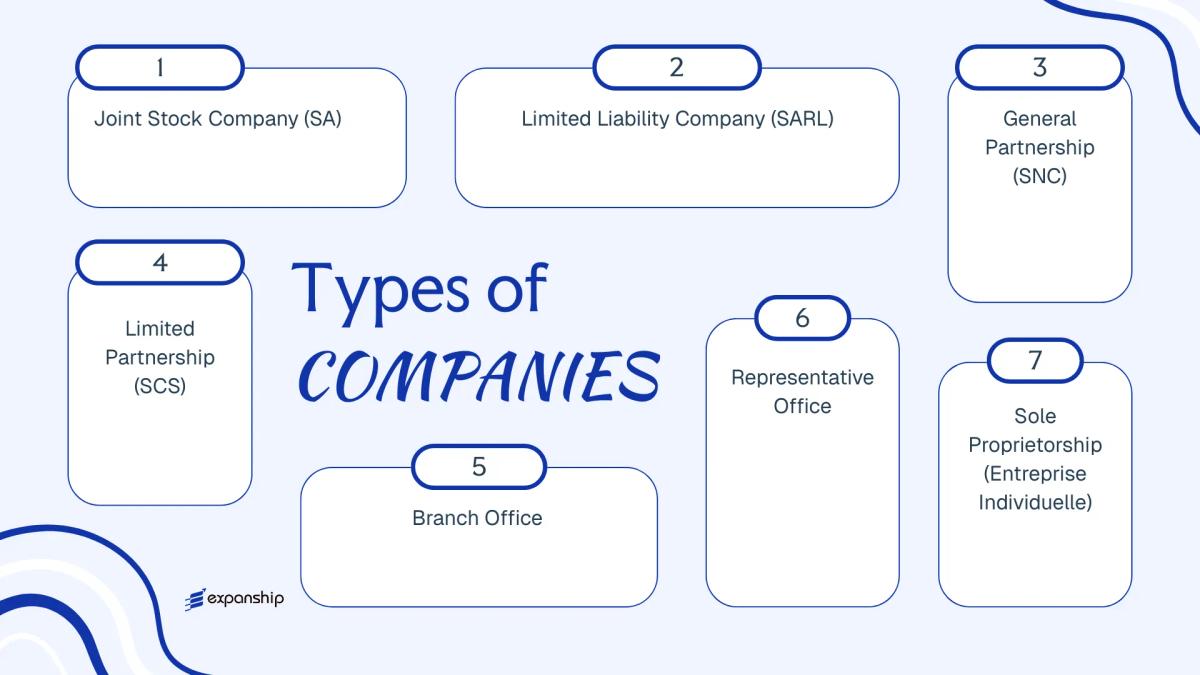
An Overview of Business Structures in Comoros
Comorian company law recognises several distinct legal forms, governed primarily by the OHADA Uniform Act on Commercial Companies and Economic Interest Groups, which the Union of the Comoros adopted upon joining the Organisation for the Harmonisation of Business Law in Africa. Each structure carries different implications for liability, ownership, taxation, and permitted commercial activity. The sections that follow examine each form in detail.
Business Structures at a Glance
| Entity Type | Legal Form | Liability | Taxed / Exempt | Local Trading | Minimum Members | Regulatory Authority | Governing Act |
|---|---|---|---|---|---|---|---|
| Société Anonyme (SA) | Joint Stock Company | Limited to shares | Taxed | Yes | 1 shareholder | CCIA / RCCM | OHADA Uniform Act |
| Société à Responsabilité Limitée (SARL) | Limited Liability Company | Limited to contribution | Taxed | Yes | 1 member | CCIA / RCCM | OHADA Uniform Act |
| Société en Nom Collectif (SNC) | General Partnership | Unlimited, joint | Taxed | Yes | 2 partners | CCIA / RCCM | OHADA Uniform Act |
| Société en Commandite Simple (SCS) | Limited Partnership | Mixed | Taxed | Yes | 2 partners | CCIA / RCCM | OHADA Uniform Act |
| Branch Office | Foreign entity extension | Parent liability | Taxed | Yes | N/A | CCIA / RCCM | OHADA Uniform Act |
| Representative Office | Non-trading presence | Parent liability | Generally exempt | No | N/A | CCIA / RCCM | OHADA Uniform Act |
| Entreprise Individuelle | Sole Proprietorship | Unlimited, personal | Taxed | Yes | 1 owner | CCIA / RCCM | OHADA Uniform Act |
Each of these structures is examined in full in the sections below.
Société Anonyme (SA) — Joint Stock Company
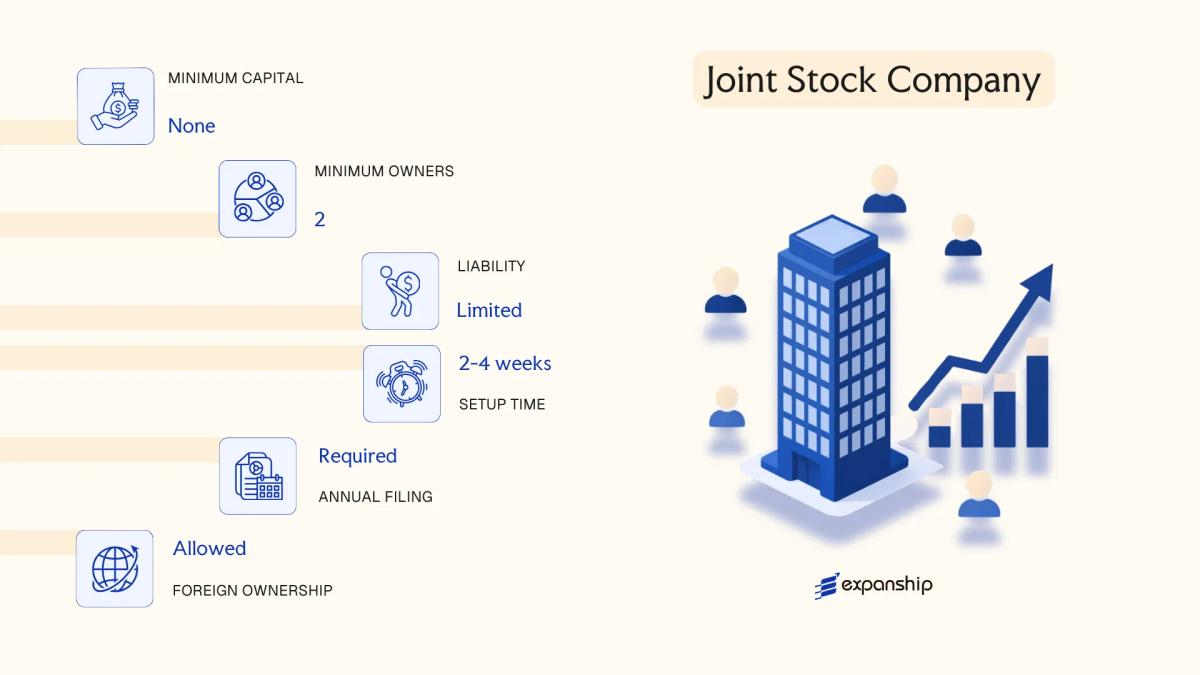
Société Anonyme SA Comoros registration is governed by the Organisation pour l'Harmonisation en Afrique du Droit des Affaires (OHADA) Uniform Act on Commercial Companies and Economic Interest Groups, which the Comoros formally adopted. Under this framework, the SA holds a distinct legal personality separate from its shareholders, and liability is capped at each shareholder's capital contribution.
The structure suits entities that intend to raise capital from multiple investors or operate at a larger commercial scale. Shares are transferable, and the entity can, in principle, be listed on a stock exchange, giving it a degree of flexibility that simpler structures do not offer.
Key Characteristics
| Requirement | Detail | Notes |
|---|---|---|
| Legal Form | Société Anonyme (SA) | Separate legal personality; governed by OHADA Uniform Act |
| Members | Shareholders (minimum 1, no statutory maximum) | OHADA permits single-shareholder SAs; shareholders elect a Board of Directors or an Administrator |
| Management | Board of Directors (minimum 3 members) or sole Administrator | Sole Administrator structure available for single-shareholder SAs |
| Local Presence | Registered office in Comoros required | No mandatory resident director, but a local registered address must be maintained |
| Capital | Minimum KMF 1,000,000 (approx. USD 2,200); paid-up at registration | At least 25% of subscribed capital must be paid upon incorporation |
| Privacy | Shareholder details filed with the commercial registry | Beneficial ownership disclosure requirements apply under applicable AML frameworks |
Focus Points
- Taxation: Corporate income tax applies at the standard rate; VAT obligations arise where thresholds are met; withholding tax may apply to dividends, interest, and royalties paid to non-residents — consult the Direction Générale des Impôts for current rates.
- Annual Compliance: Annual general meetings, audited financial statements (statutory auditor mandatory above certain thresholds), and filing with the RCCM (Registre du Commerce et du Crédit Mobilier) are required.
- Economic Substance: No formal substance regime equivalent to certain offshore centres applies, but the entity must maintain genuine operational links to its registered jurisdiction.
- Treaty Access: Comoros has a limited bilateral tax treaty network; verify applicable treaty coverage before structuring cross-border flows through this entity.
- Conversion: An SA may be converted to a SARL or other OHADA-recognised form by shareholder resolution, subject to regulatory approval and capital adjustment requirements.
Closing
The SA suits holding structures, larger trading operations, and businesses that anticipate future investment rounds or eventual public offering. The transferable share structure is an advantage for ownership succession and third-party investment, but the mandatory auditor requirement and higher minimum capital make it a more administratively intensive option than simpler entities.
The SA is most appropriate for businesses expecting multiple investors, significant capitalisation, or a longer-term path toward institutional financing.

Company Incorporation in Comoros
Incorporate an SA or other entity type in Comoros with end-to-end support from Expanship's corporate services team.
Société à Responsabilité Limitée (SARL) — Limited Liability Company
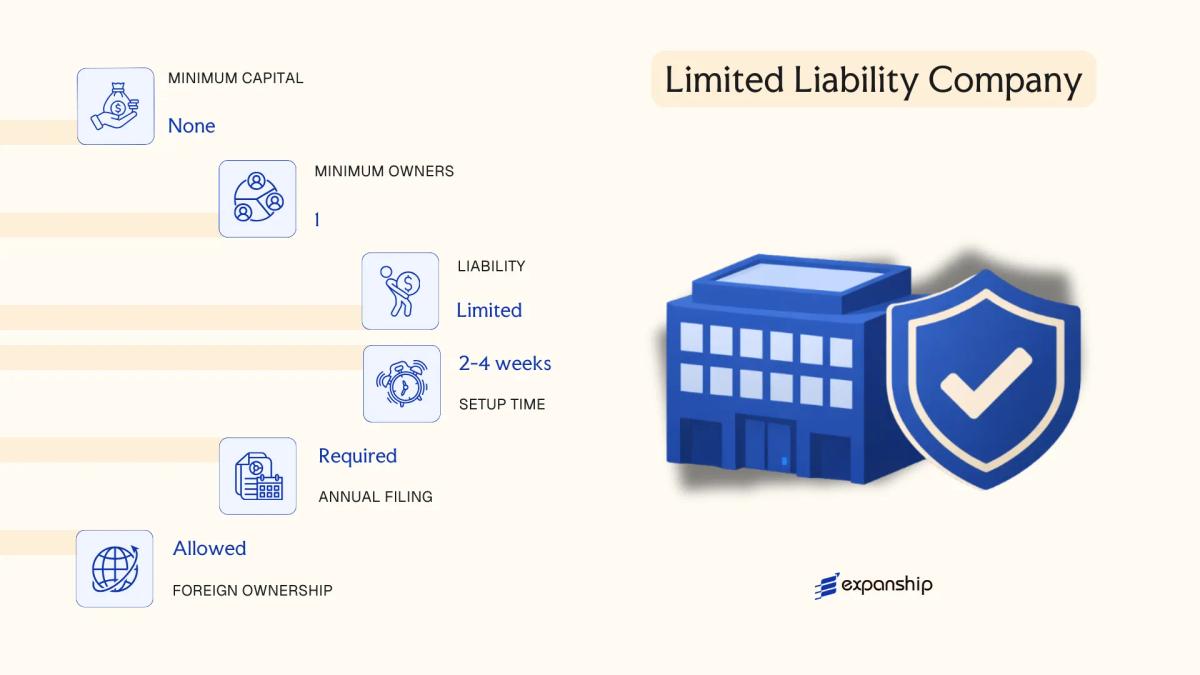
SARL company formation in Comoros is governed by the OHADA Uniform Act on Commercial Companies and Economic Interest Groups, which Comoros adopted as part of its integration into the OHADA legal framework. The SARL is a hybrid structure, combining the liability protection of a corporation with the operational flexibility of a partnership.
As a distinct legal entity, the SARL holds rights and obligations in its own name, separate from its members. Liability is capped at each member's capital contribution, meaning personal assets are not exposed to business debts.
Key Characteristics
| Requirement | Detail | Notes |
|---|---|---|
| Legal Form | Société à Responsabilité Limitée | Separate legal personality under OHADA |
| Members | 1–50 associates (associés) | A single-member variant (SARL unipersonnelle) is permitted |
| Management | One or more gérants (managers) | Need not be a member; no nationality restriction under general OHADA rules |
| Local Presence | Registered office address required | A physical or legal address within the jurisdiction |
| Capital | No statutory minimum under OHADA; denominated in Comorian Franc (KMF) | Capital divided into parts sociales, not negotiable shares |
| Privacy | Member names filed with the registry | Not publicly listed on an exchange; limited public disclosure |
Focus Points
- Taxation: Subject to corporate income tax on profits; VAT applies to qualifying transactions; withholding tax may apply to dividends and service payments; consult current rates with local tax authority (Direction Générale des Impôts).
- Annual Compliance: Annual accounts must be filed; general assembly of associates required each fiscal year.
- Treaty Access: Comoros has a limited tax treaty network; SARL entities may have restricted access to double taxation relief.
- Conversion: An SARL may be converted to an SA once membership and capital thresholds are met under OHADA provisions.
- Restrictions: Parts sociales are not freely transferable; third-party transfers require associate approval.
Closing
The Comoros SARL suits small to mid-sized trading, services, or holding operations where owners want liability protection without the formality of a joint stock structure. The absence of a statutory minimum capital requirement lowers the entry threshold, though the restriction on share transferability can complicate investor entry or exit.
The SARL is best suited for closely held businesses, family-owned ventures, or founder-led trading and service companies seeking liability protection with minimal structural overhead.
Partnerships in Comoros [Société en Nom Collectif (SNC), Société en Commandite Simple (SCS)]
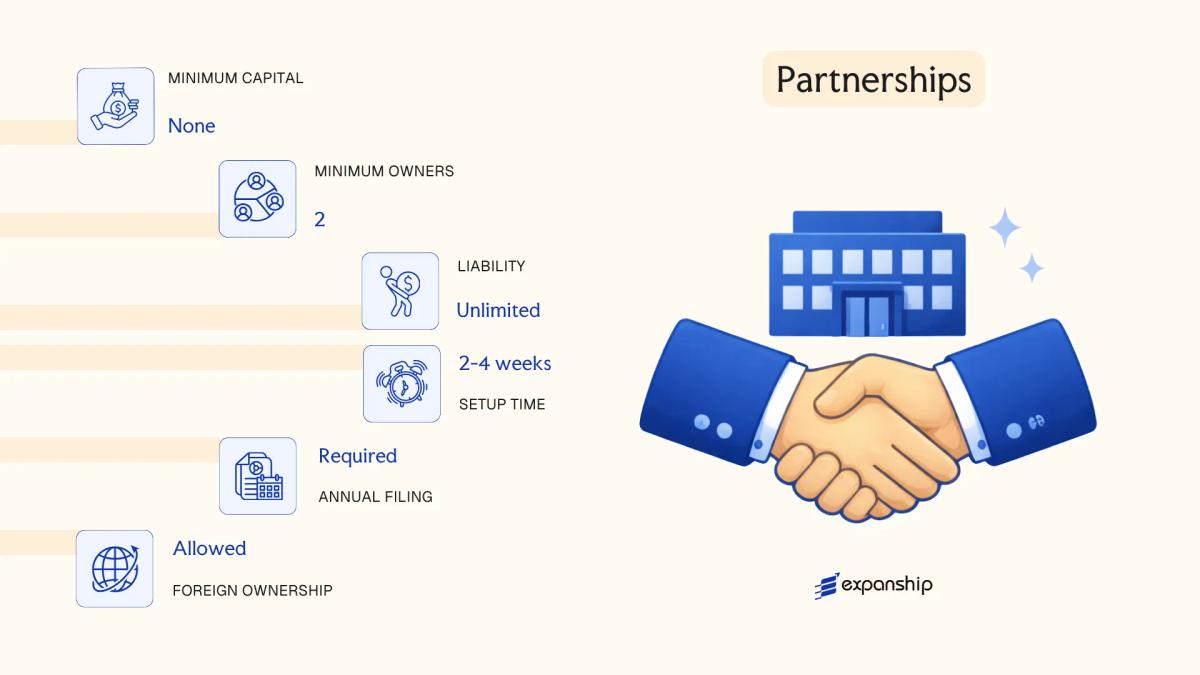
Both SNC SCS partnership structures in Comoros are governed by the Organisation pour l'Harmonisation en Afrique du Droit des Affaires (OHADA) Uniform Act on Commercial Companies and Economic Interest Groups. The SNC is a general partnership in which all associates bear unlimited joint and several liability for the firm's debts.
The Société en Commandite Simple introduces a two-tier membership structure: at least one general partner (commandité) with unlimited liability and one or more limited partners (commanditaires) whose exposure is capped at their capital contribution. Neither structure is commonly used for large commercial operations; both tend to appear in family-owned businesses or professional service arrangements.
Key Characteristics
| Requirement | SNC | SCS | Notes |
|---|---|---|---|
| Legal Form | General Partnership | Limited Partnership | Both have separate legal personality under OHADA |
| Members | Minimum 2 associates (no maximum) | Min. 1 commandité + 1 commanditaire | Commanditaires in SCS cannot manage the business |
| Liability | Unlimited for all | Unlimited for commandités; limited for commanditaires | Creditors may pursue associates personally in SNC |
| Registered Office | Required in Comoros | Required in Comoros | Must maintain a local address on record |
| Capital | No statutory minimum | No statutory minimum | Contributions can be in cash or in kind |
| Privacy | Associate names disclosed in registration | Commandité names disclosed; commanditaires may have limited exposure | Both file with the Registre du Commerce et du Crédit Mobilier (RCCM) |
Focus Points
- Taxation: Partnerships are generally subject to corporate income tax under Comorian fiscal rules; profit distributions may attract withholding tax, and VAT obligations apply where applicable thresholds are met.
- Annual Compliance: Both structures must maintain accounting records and file annual returns with the RCCM.
- Treaty Access: Comoros has a limited tax treaty network, which restricts withholding tax relief for distributions to foreign partners.
- Conversion: An SNC can be converted to an SA or SARL by unanimous associate consent, subject to OHADA procedural requirements.
- Restrictions: Commanditaires in an SCS are prohibited from performing management acts; doing so exposes them to unlimited liability.
Sub-Types
Société en Nom Collectif (SNC)
The SNC is the standard general partnership form under OHADA, where every associate holds full management rights alongside unlimited personal liability. It is most commonly used for small, closely held trading or professional businesses where partners know and trust one another directly.
Société en Commandite Simple (SCS)
The SCS separates operational control from passive investment by distinguishing between managing general partners and contributing limited partners. This structure suits arrangements where one party provides capital without wishing to participate in day-to-day management.
When to Consider a Partnership Structure
These structures suit closely held family businesses or professional arrangements where partners accept personal liability in exchange for operational simplicity. The absence of a minimum capital requirement is a practical advantage, though unlimited liability for general partners remains a significant constraint for commercially exposed ventures.
SNC and SCS structures are best suited for small, trust-based business arrangements — particularly family enterprises or professional partnerships — rather than externally funded commercial operations.
Foreign Business Structures in Comoros [Branch Office, Representative Office]
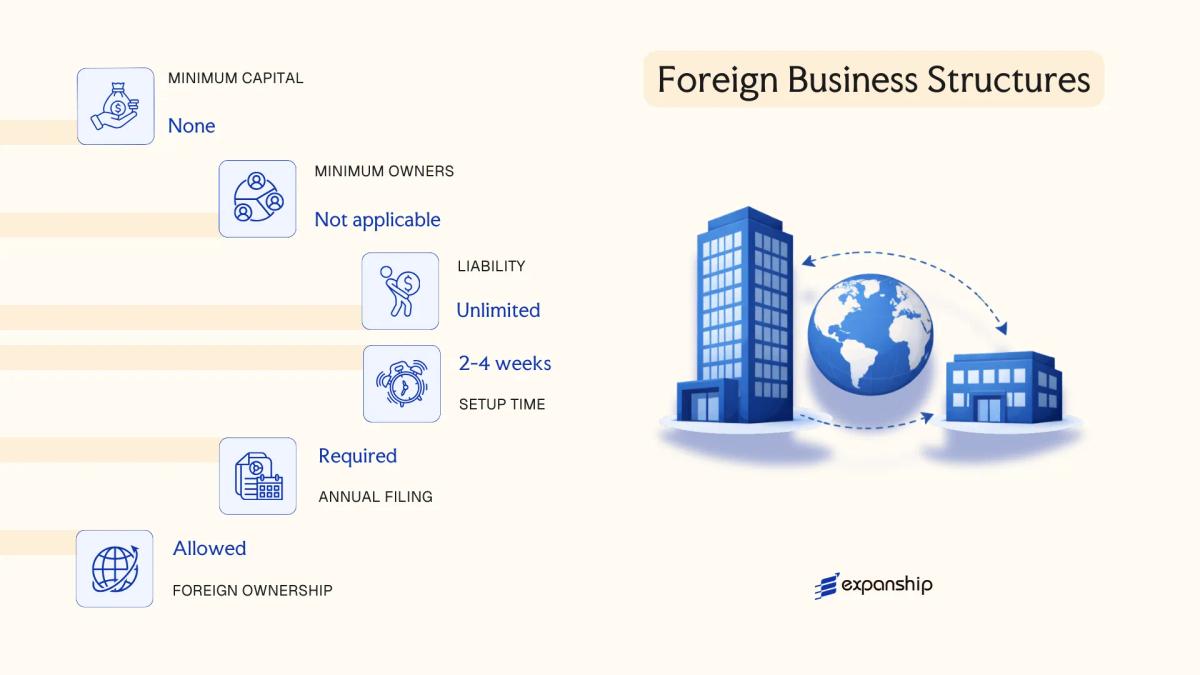
Foreign companies seeking a presence in the Comoros Islands without incorporating a separate local entity generally operate through a branch office or representative office. A foreign branch office setup in Comoros is governed under the OHADA Uniform Act on Commercial Companies and Economic Interest Groups, which the Comoros adopted upon joining the OHADA treaty framework. A branch has no independent legal personality — it remains an extension of the parent company, which bears full liability for its obligations.
A representative office occupies a more restricted position. It is permitted to conduct market research, liaison activities, and promotional work, but cannot engage in direct commercial transactions or revenue-generating operations.
Key Characteristics
| Requirement | Branch Office | Representative Office |
|---|---|---|
| Legal Personality | None — extension of parent company | None — extension of parent company |
| Commercial Activity | Permitted | Not permitted |
| Liability | Parent company bears full liability | Parent company bears full liability |
| Local Presence | Registered address required in Comoros | Registered address required |
| Registration Body | Registre du Commerce et du Crédit Mobilier (RCCM) | RCCM; may require additional ministerial approval |
| Capital Requirement | No separate minimum capital; parent's capital applies | None |
Focus Points
- Taxation: Branch profits are subject to corporate income tax at the standard rate applicable to Comorian-resident entities; withholding tax may apply to profit remittances to the parent; VAT obligations follow the nature of transactions conducted.
- Substance obligations: A branch conducting active operations must maintain genuine local management and bookkeeping in Comoros.
- Annual compliance: Branches must file audited accounts and annual returns with the RCCM; parent company constitutional documents must remain current and apostilled.
- Treaty access: Comoros has a limited double tax treaty network, which may restrict the parent entity's ability to claim relief on branch profits.
- Restrictions: Representative offices are explicitly barred from invoicing clients or repatriating commercial revenue.
Sub-Types
Branch Office
A branch is registered under the OHADA framework and can execute contracts, employ staff, and generate local revenue. It is the standard vehicle for foreign firms testing the Comorian market before committing to full local incorporation.
Representative Office
Distinguished from a branch by its non-commercial mandate, a representative office suits foreign companies whose immediate objective is market intelligence, partner liaison, or brand presence rather than direct trade.
A branch office is the more practical structure for foreign firms intending to conduct active business, while a representative office serves organisations with non-commercial or preparatory objectives. The principal limitation of both structures is the absence of liability separation from the parent entity.
Both structures are best suited to established foreign companies that need a controlled, low-commitment market entry point before deciding whether to incorporate a standalone Comorian entity.
Sole Proprietorship (Entreprise Individuelle)
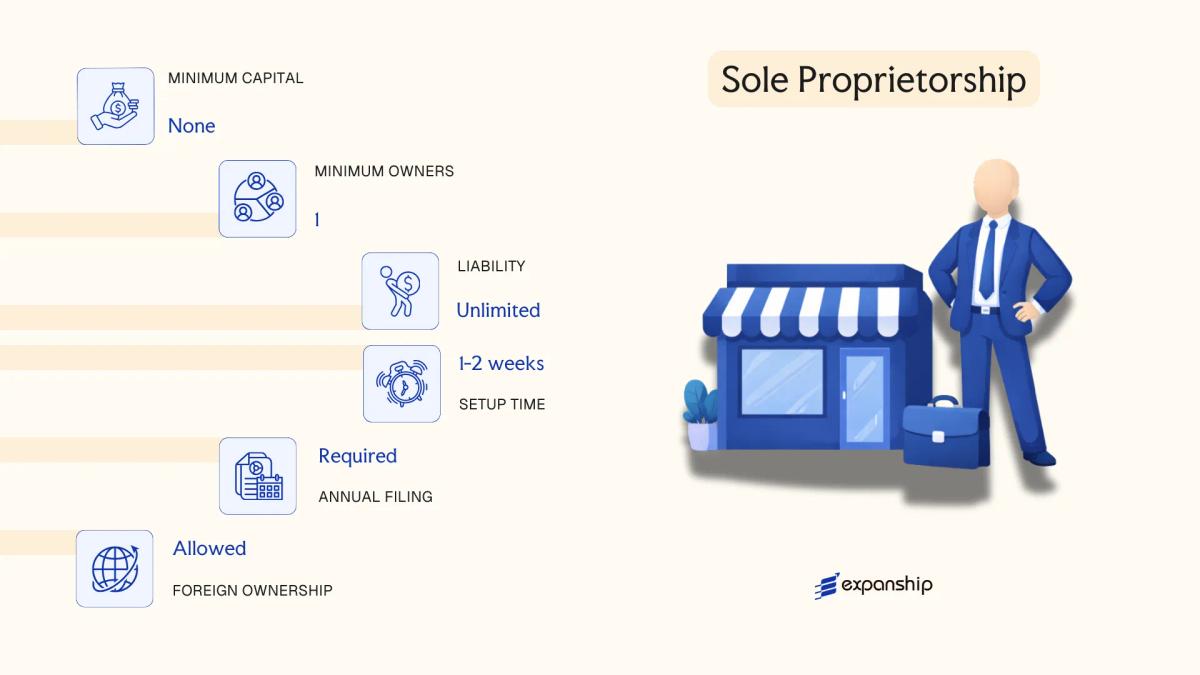
The sole proprietorship Comoros Entreprise Individuelle framework provides the most direct path to self-employment for individuals conducting business in their own name. Governed by the OHADA Uniform Act on General Commercial Law, which the Union of the Comoros adopted upon accession to the OHADA treaty, this structure carries no separate legal personality. The proprietor and the business are treated as one legal person, meaning personal assets remain fully exposed to business liabilities.
Registration is handled through the Tribunal de Commerce or the designated commercial registry, where the individual must declare their trade activity and obtain a registration number. Comoros self-employment business registration under this form is administratively straightforward relative to incorporated structures, though it offers no liability shield.
Key Characteristics
| Requirement | Detail | Notes |
|---|---|---|
| Legal Form | Sole Proprietorship (Unincorporated) | No separate legal personality from the proprietor |
| Member Title | Proprietor (Exploitant individuel) | Single individual only; no partners or shareholders |
| Minimum Capital | None prescribed | No statutory minimum capital requirement |
| Local Presence | Registered business address required | Must correspond to principal place of activity |
| Liability | Unlimited personal liability | Personal assets are directly at risk for business debts |
| Privacy | Name of proprietor is publicly registered | Business trades under the proprietor's own name |
Focus Points
- Taxation: Profits are taxed as personal income under the individual income tax regime; no separate corporate tax applies, and VAT registration thresholds may apply depending on annual turnover.
- Annual Compliance: Annual declaration of income to the Direction Générale des Impôts is required; accounting obligations are lighter than those for incorporated entities.
- Conversion: The Entreprise Individuelle can be converted into an incorporated entity such as a SARL, though this requires a formal dissolution and re-registration process.
- Treaty Access: As an unincorporated structure, access to double tax treaty benefits is limited and generally governed by the proprietor's personal tax residency status.
- Restrictions: Non-residents may face practical barriers to registration, as the structure presupposes a physically present individual conducting trade.
Closing Paragraph
The Entreprise Individuelle suits resident individuals operating small-scale trading, artisan, or service activities where administrative simplicity outweighs the need for liability protection. Its primary advantage is minimal formation cost and straightforward compliance; its central drawback is unlimited personal liability, which poses significant financial risk as business activity scales.
This structure is best suited for resident individual traders or artisans conducting low-risk, small-scale commercial activity who do not require liability separation.
How to Choose the Right Entity Type in Comoros
Selecting the right entity type is a structural decision with direct legal and financial consequences — not a formality. Knowing how to choose a business entity type in Comoros requires mapping your operational objectives against what each structure actually permits under Comorian company law.
Why Your Entity Choice Matters
Registering the wrong structure creates concrete, documented problems:
- Registering an offshore entity such as an International Business Company when you intend to trade locally constitutes a breach of applicable regulations and can result in administrative penalties or involuntary dissolution.
- Choosing a tax-exempt entity when your business requires access to double taxation agreements means withholding tax reductions available under those treaties cannot be claimed.
- Selecting a structure incapable of demonstrating local substance when substance requirements apply exposes the entity to reporting failures and associated fines.
- Forming a shareholding company when asset protection or succession planning is the primary goal locks the business into annual shareholder obligations that serve no purpose in that context.
Key Factors to Consider
- Business Activity: Active trading, passive asset-holding, and regulated sectors each correspond to distinct structures under Comorian law.
- Local vs. Offshore Operations: Whether your firm will transact with Comorian residents determines whether a domestic or offshore registration applies.
- Ownership and Management: Single-owner operations and multi-party arrangements have different governance requirements across SARLs, SAs, and partnerships.
- Tax Objectives: Your need for full exemption, a specific regime, or treaty eligibility directly narrows which entity qualifies.
- Substance Capacity: If maintaining a physical presence is not feasible, the entity type must align with applicable substance thresholds.
- Exit Strategy: Not all Comorian structures permit redomiciliation or conversion, so your intended exit route should factor into formation decisions.
The primary legislation governing company formation is the OHADA Uniform Act on Commercial Companies, which applies across member states including Comoros and sets the binding framework for entity formation, governance, and dissolution.
Compliance Services for Companies in Comoros
Ongoing compliance support for Comorian entities, including annual filings, registered agent maintenance, and regulatory reporting.
Conclusion
Incorporating a company in Comoros Islands requires selecting a structure that aligns with your operational scope, ownership preferences, and tax position. The SA suits larger enterprises requiring broad share capital and formal governance, while the SARL remains the most commonly registered entity among small to mid-sized businesses due to its lower capital threshold and flexible management. Partnerships such as the SNC and SCS expose at least some partners to unlimited liability, making them less common in practice. Branch and representative offices serve foreign firms that need a local presence without a separate legal entity. The sole proprietorship carries the fewest formation requirements but offers no liability protection.
Regulated under the OHADA Uniform Act on Commercial Companies, Comoros corporate law follows a regional framework that continues to evolve alongside broader OHADA reform efforts. Ongoing treaty discussions and incremental regulatory updates suggest a gradual trajectory toward greater formal recognition in international commercial circles. Understanding where the framework currently stands helps you approach entity selection with realistic expectations about compliance obligations and structural limitations.
How Expanship Can Assist You
Expanship company incorporation services Comoros cover the full process of registering an SA, SARL, or any other entity type through the Agence Nationale pour la Promotion des Investissements (ANPI) and the relevant commercial registry. From selecting the right structure for your operational goals to meeting the Union's specific capital and documentation requirements, your business receives practical, jurisdiction-specific guidance at every stage.
Expanship's service scope as a corporate services provider in Comoros includes:
- Document preparation, notarization, and legalization
- Registered agent and registered office provision
- Government filing and commercial registry liaison
- Post-incorporation compliance management
- Banking introduction assistance
Reach out to Expanship Comoros to discuss how we can support your Comoros business setup.
Frequently Asked Questions (FAQ)
The Société à Responsabilité Limitée (SARL) is the most frequently registered structure. Its lower capital requirements and simpler governance rules make it accessible to small and medium-sized enterprises operating domestically.
An SA requires a higher minimum share capital and must have at least seven shareholders, while an SARL can be formed with a single associate. The SA is structured for larger operations seeking public investment, whereas an SARL carries lighter ongoing disclosure obligations under the OHADA Uniform Act on Commercial Companies.
Among registered structures, the SARL generally involves fewer mandatory public disclosures than the SA, which must publish financial accounts. Nominee arrangements are not formally prohibited but must comply with beneficial ownership registration requirements enforced through the Comorian regulatory framework.
No. A Société en Nom Collectif (SNC) and a Société en Commandite Simple (SCS) each require at least two partners by definition. An SARL, by contrast, can be formed by a single associate, and a Sole Proprietorship is inherently a one-person structure.
Foreign nationals may register an SARL or SA without a local partner requirement, subject to sectoral restrictions. Certain regulated industries may require prior government approval regardless of entity type.
The SARL, SA, SNC, and SCS all hold separate legal personality under OHADA rules. A Sole Proprietorship does not — the owner and the business remain legally the same person, meaning personal assets are exposed to business liabilities.
Conversion between entity types is generally permitted under OHADA commercial law, most commonly from an SARL to an SA as a business grows. The process requires shareholder resolutions, updated articles, and re-registration with the competent commercial registry.
Legal Disclaimer
The information provided in this article is for general informational purposes only and does not constitute legal, tax, or professional advice. While we strive to ensure the accuracy and timeliness of the content, laws and regulations are subject to change, and the application of laws can vary widely based on specific facts and circumstances.
Readers should not act upon this information without seeking professional counsel tailored to their individual situation. Expanship and its authors disclaim any liability for actions taken or not taken based on the content of this article.
For specific advice regarding your business setup, compliance requirements, or any legal matters, please consult with qualified legal and tax professionals in the relevant jurisdiction.