
Key Takeaways
- Cameroon's membership in OHADA provides foreign investors with access to a unified, codified commercial legal framework shared across member states, reducing the legal unpredictability that typically elevates risk in sub-Saharan African markets.
- The CEMAC free trade zone extends the commercial reach of a Cameroon-registered entity across six Central African economies, allowing a single incorporated structure to serve a regional market without duplicating formation costs.
- Under Cameroon's Investment Charter, qualifying businesses can access fiscal incentives during the establishment phase, directly lowering the effective tax burden in the years when capital outlay is highest.
- Operating in both French and English as official languages positions a Cameroon entity to engage counterparties, regulators, and clients across Francophone and Anglophone African markets without structural language barriers.
Cameroon is an independent republic in Central Africa, bordered by Nigeria, Chad, the Central African Republic, and the Gulf of Guinea. The country's company registration process falls under the oversight of the Centre de Formalités des Créations d'Entreprises (CFCE), which serves as the single-window authority for business formation procedures. Foreign investors most commonly establish a Société à Responsabilité Limitée when entering the market. The general tax posture is treaty-based, with Cameroon participating in regional and bilateral frameworks that shape how corporate income is treated across borders.
Openness to foreign direct investment is reflected in the legal framework — foreign nationals can hold full ownership in most sectors, with certain regulated industries subject to specific conditions under applicable law. The benefits of incorporating in Cameroon span regulatory structure, market access, and economic diversity, and this article examines those advantages in detail.
Expanship works with clients on Cameroon company formation across a range of industries, from natural resources to professional services.
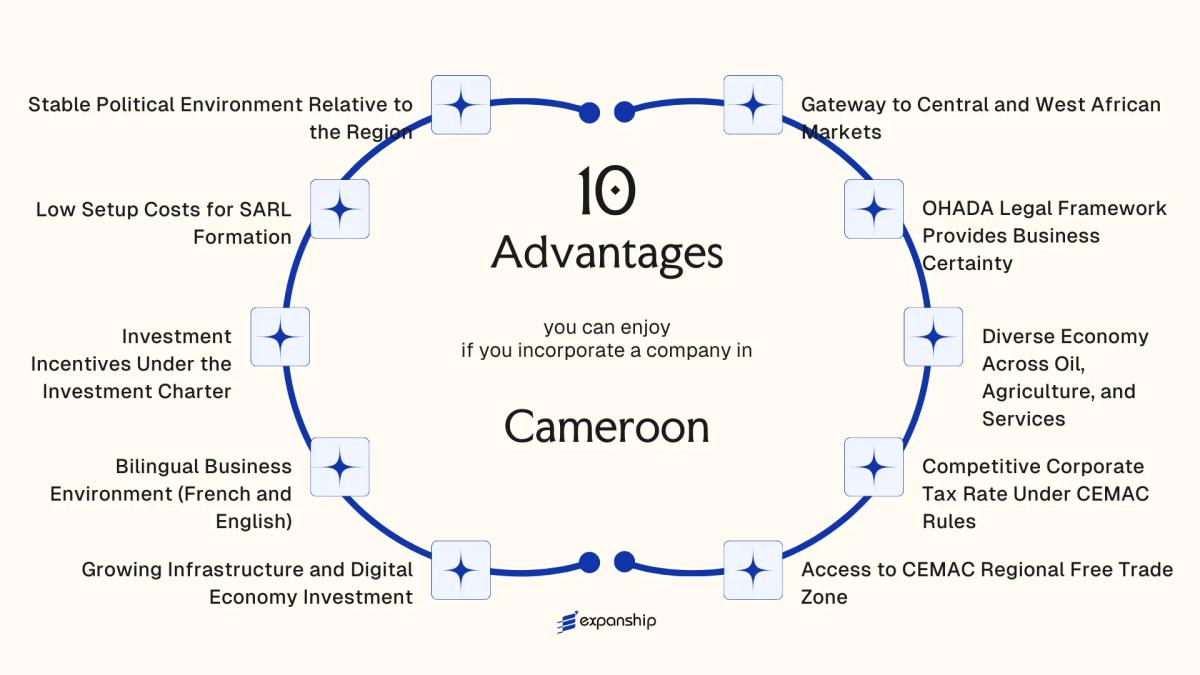
Gateway to Central and West African Markets
Cameroon's geographic position makes it a functional entry point — sitting at the junction where Central Africa meets the Gulf of Guinea coast, with land borders connecting it to six countries including Nigeria, Chad, and the Central African Republic. For a foreign business, this translates directly into physical and commercial reach across two of Africa's most commercially active sub-regions, with Cameroon as gateway to Central African markets and a staging point toward West Africa's large consumer base.
Dual Sub-Regional Access Through One Incorporated Entity
A company registered here can trade across CEMAC member states — Chad, Gabon, Republic of Congo, Equatorial Guinea, and Central African Republic — without re-incorporating in each territory. That operational scope from a single legal entity reduces the administrative and capital cost of multi-country expansion significantly.
Port Infrastructure as a Commercial Anchor
The Port of Douala processes the majority of landlocked Central African nations' imports and exports, making it a transit hub by default. Your firm's physical presence near this corridor positions it within established trade routes that neighbouring landlocked markets depend on structurally.
One incorporated entity in Cameroon can serve as your operational base for trading across six CEMAC member states without requiring separate legal registrations in each.
OHADA Legal Framework Provides Business Certainty
Cameroon is a member of OHADA (Organisation pour l'Harmonisation en Afrique du Droit des Affaires), the regional body that has unified commercial law across 17 African member states. The OHADA legal framework benefits Cameroon-based businesses by replacing fragmented national commercial codes with a single, predictable set of rules governing company formation, contracts, securities, insolvency, and dispute resolution.
The practical advantage for your business is consistency. When a foreign investor structures an entity under the Acte Uniforme on Commercial Companies, the same legal text applies across all OHADA member states. This removes the uncertainty that typically comes with operating in multiple African jurisdictions under different legal systems.
Dispute resolution is handled through the CCJA (Common Court of Justice and Arbitration), which serves as the supreme court for OHADA commercial matters. Having access to a supranational court — rather than relying solely on domestic courts — gives foreign investors a recognized, neutral forum for resolving commercial disputes.
Several structural features of the OHADA framework make it particularly workable for foreign-owned entities:
- Company formation rules are codified in a single Acte Uniforme, so there is no ambiguity about what form your entity must take
- Capital requirements and governance rules are defined at the regional level, reducing the risk of arbitrary local interpretation
- The framework recognizes and enforces arbitral awards across all member states, protecting cross-border agreements

Company Incorporation in Cameroon
Register your company in Cameroon under the OHADA legal framework with full compliance support from Expanship.
Diverse Economy Across Oil, Agriculture, and Services
Cameroon's diverse economy benefits for businesses stem from a structural reality: no single sector dominates the country's GDP. Oil extraction, cocoa and coffee agriculture, timber, and a growing services sector each contribute meaningfully, which means your business is not entering a mono-commodity market where one price cycle can destabilize the entire economy.
For foreign investors, this spread has a direct practical consequence. A firm operating in agro-processing can access domestic raw material supply chains that are well-established and formally regulated under the Ministry of Agriculture and Rural Development. A company in energy services can position itself around upstream oil activity in the Rio del Rey and Douala basins without depending on the same client base as a trading firm.
| Sector | Key Activities | Relevant Regulatory Body |
|---|---|---|
| Oil and Gas | Upstream extraction, refining | National Hydrocarbons Corporation (SNH) |
| Agriculture | Cocoa, coffee, palm oil, timber | Ministry of Agriculture and Rural Development |
| Services | Finance, telecoms, transport | Ministry of Posts and Telecommunications |
| Manufacturing | Agro-processing, construction materials | Ministry of Industries, Mines and Technological Development |
Multi-sector investment opportunities reduce concentration risk at the entity level. If your business model involves regional distribution, the diversity of exportable commodities means you can structure supply agreements across more than one industry without operating in an isolated niche. The economic diversification benefits of incorporating here are grounded in this sectoral breadth, not in projections or policy aspirations.
Competitive Corporate Tax Rate Under CEMAC Rules
Cameroon's competitive corporate tax rate under CEMAC sits at 33% on net taxable profits, governed by the General Tax Code (Code Général des Impôts) and harmonised under the CEMAC tax convergence framework. For foreign investors comparing entry points across the region, this rate applies uniformly to resident companies regardless of foreign ownership structure.
Under CEMAC rules, member states follow shared fiscal convergence criteria that constrain extreme tax undercutting while still permitting competitive positioning. Your business operating through a Cameroonian entity benefits from a defined, predictable rate rather than discretionary assessments, which reduces exposure to arbitrary tax treatment.
A minimum tax (impôt minimum forfaitaire) applies when the standard IS calculation produces nil or low liability, calculated as a percentage of turnover. This acts as a floor, so entities with low declared profits still carry a base obligation. Understanding this mechanism prevents underestimating effective tax cost during low-revenue years.
Keep these points in mind:
- The IS rate of 33% applies to net taxable profit, not gross revenue
- The minimum forfaitaire applies even when net profit is zero
- CEMAC harmonisation limits unilateral rate changes, providing medium-term stability
- Tax treaties with France and other states may reduce withholding on dividends remitted abroad
The Direction Générale des Impôts (DGI) administers corporate tax filings and assessments.
Cameroon retains a separate business licence tax (patente) distinct from IS, meaning your entity's total fiscal obligation is not fully captured by the headline corporate rate alone.
Access to CEMAC Regional Free Trade Zone
Cameroon CEMAC free trade zone benefits extend to any company incorporated within its borders, granting automatic participation in a regional economic bloc that covers six Central African nations. The Economic and Monetary Community of Central Africa (CEMAC) operates a customs union under which goods produced within member states circulate without internal customs duties, giving your business a structural cost advantage across a combined market of roughly 60 million people.
Tariff-Free Movement Within the Bloc
Under the CEMAC common external tariff (CET) framework, goods that qualify as originating within the union move between member states free of import duties. For a foreign-owned entity incorporated locally, this means manufactured or processed goods can reach buyers in Chad, Gabon, the Republic of Congo, the Central African Republic, and Equatorial Guinea without the customs friction that non-member firms face at each border. Rules of origin criteria apply, so the benefit is tied to where substantive production or processing occurs, not simply where the entity is registered.
A Single Monetary Zone and Shared Regulatory Base
All six CEMAC members share the CFA franc (XAF), administered by the Banque des États de l'Afrique Centrale (BEAC). Operating across the bloc does not expose your business to intra-regional currency conversion costs. Regional trade is also governed through harmonized instruments, including the OHADA treaty framework for commercial law, reducing the legal complexity of contracting with counterparties in other member states.
Maximize Your CEMAC Market Access from Cameroon
Speak with an Expanship specialist about structuring your Cameroon entity to fully qualify for CEMAC regional trade benefits and customs union provisions.
Growing Infrastructure and Digital Economy Investment
Cameroon digital economy investment benefits have become more tangible since the government formalized its Digital Economy Strategy, which targets expanded broadband access, e-government services, and a structured ICT sector. For foreign firms, this trajectory matters because it signals improving operational infrastructure rather than static conditions.
- The government established the Ministry of Posts and Telecommunications to coordinate digital infrastructure policy, giving investors a defined regulatory counterpart rather than a fragmented oversight environment.
- Yaounde and Douala host growing technology hubs and co-working ecosystems, reducing the fixed-cost burden for firms entering the market without a legacy physical presence.
- Fiber optic connectivity has expanded through submarine cable access, including the SAT-3 and ACE cables, which improves bandwidth reliability for firms dependent on cross-border data exchange.
- The Investment Promotion Agency (API) identifies ICT and digital services among priority sectors, which can make your business eligible for targeted incentives under the 2002 Investment Charter.
- Infrastructure spending under successive national development plans has extended road and energy networks, reducing logistics costs that directly affect supply chain margins for goods-based businesses.
- Mobile penetration rates support digital payment adoption, lowering transaction friction for firms building consumer-facing or B2B service models without requiring legacy banking infrastructure.
Bilingual Business Environment (French and English)
Cameroon bilingual business environment advantages extend beyond cultural identity. The country operates officially under both French and English, a structure codified in the 1996 Constitution, with the anglophone Northwest and Southwest Regions conducting public affairs in English and the remaining eight regions operating in French.
For a foreign business owner, this duality has a direct operational benefit. Your firm can engage francophone counterparts across Central Africa while simultaneously communicating with anglophone partners in West Africa and international markets without requiring translation intermediaries at every stage.
Legal and administrative documentation issued by the Centre de Formalités de Création des Entreprises (CFCE) is accessible in both languages, reducing the friction that typically accompanies cross-border registration processes in other CEMAC member states.
- English-speaking investors from the UK, US, Canada, or Nigeria can conduct due diligence and negotiate contracts without language barriers.
- French-speaking partners across Gabon, Chad, or Côte d'Ivoire operate within a familiar administrative and legal vocabulary.
A foreign-owned entity registered through the CFCE can, in practice, execute shareholder agreements, tax filings, and supplier contracts in either official language, halving the documentation translation costs that would otherwise apply in a single-language jurisdiction.
Investment Incentives Under the Investment Charter
Cameroon Investment Charter incentives for businesses are governed by Law No. 2013/004 of 18 April 2013, which establishes the general framework for private investment and defines the fiscal advantages available to qualifying firms across different phases of business activity.
The Charter structures incentives around two main regimes:
- The establishment phase regime, which covers duties and taxes on imported equipment, raw materials, and construction inputs used to set up operations
- The operation phase regime, which grants exemptions or reductions on certain business taxes once the entity is generating revenue
For foreign investors, the practical value lies in the predictability these codified exemptions provide. Instead of negotiating concessions on a case-by-case basis, your business enters a defined legal framework with published eligibility criteria tied to investment thresholds and sector categories.
Agro-industrial, manufacturing, and export-oriented businesses tend to receive the most direct fiscal relief under the Charter's provisions. The Investment Promotion Agency (API-Cameroun) serves as the administrative body responsible for processing applications and issuing the formal approval that activates Charter benefits.
Charter incentives are not automatic; your business must apply through API-Cameroun and receive formal approval before any fiscal exemptions take legal effect.
Low Setup Costs for SARL Formation
Cameroon SARL formation low setup costs represent a structural advantage tied directly to the OHADA Uniform Act on Commercial Companies, which governs entity formation across all 17 OHADA member states. Under this framework, the minimum share capital required to incorporate a Société à Responsabilité Limitée is set at XAF 100,000 (approximately USD 165). That threshold keeps the financial barrier to entry low for foreign investors who want legal presence in the country without committing significant capital upfront.
Capital Flexibility at Incorporation
The XAF 100,000 minimum applies regardless of whether shareholders are resident or non-resident, which means your business can be incorporated without a local partner contributing capital to meet the threshold. Share capital can be contributed in cash or in kind, giving founders flexibility in how they structure initial assets. This is particularly relevant for service-oriented businesses or consulting firms where physical assets are limited at the outset.
Reduced Administrative Overhead
Registration of a SARL is processed through the Centre de Formalités de Création d'Entreprises (CFCE), a one-stop-shop mechanism that consolidates filings across multiple agencies. Incorporation fees, notarial costs, and registration duties are generally modest relative to comparable francophone jurisdictions. For a foreign investor, the ability to complete formation through a single administrative channel reduces both the time and professional fees associated with coordinating multiple government bodies.
- Minimum share capital: XAF 100,000
- Single shareholder permitted (SARL unipersonnelle)
- Registration handled through CFCE
- Capital contributions accepted in cash or in kind
Stable Political Environment Relative to the Region
Cameroon stable political environment business benefits distinguish it from several of its immediate neighbors, a distinction that carries real weight for foreign investors assessing operational risk in Central Africa.
Relative to its neighbors in the CEMAC zone, Cameroon has maintained uninterrupted constitutional governance since independence, with Presidential authority structured under the 1972 Constitution as revised in 1996. That constitutional continuity means the legal and regulatory framework governing your business has not been subject to the abrupt resets that follow coups or unconstitutional transfers of power. For a foreign-registered entity operating under OHADA rules, predictability in the governing authority matters directly to contract enforceability and asset protection.
The country holds membership in multiple multilateral institutions, including the African Union and the United Nations, which creates external accountability mechanisms that reinforce institutional behavior. Foreign direct investment protections enshrined in the Investment Charter of 2002 (Law No. 2002/004) derive their practical force partly from this institutional stability.
Key factors that translate this stability into commercial advantage:
- Investment disputes are adjudicated through courts operating under the OHADA Uniform Acts, insulated from arbitrary executive interference by treaty-level obligations
- Currency stability is anchored by the CFA franc (XAF), pegged to the euro through the Banque des États de l'Afrique Centrale (BEAC), reducing exchange-rate exposure for European-facing businesses
- Bilateral investment treaties with multiple capital-exporting nations provide your firm with recourse mechanisms outside domestic courts
- The port of Douala continues to function as a regional logistics hub, a status that depends on the sustained administrative continuity the country has maintained
Why Cameroon Stands Out Among African Incorporation Destinations
Three jurisdictions offer the most direct comparison for foreign investors evaluating Central and West African incorporation options: Nigeria, Ghana, and the Democratic Republic of Congo. Each targets a similar investor profile, operates within broadly overlapping geographic markets, and presents incorporation structures familiar to international business owners. What the comparison reveals is not that one country is superior, but that Cameroon's combination of OHADA legal harmonisation, CEMAC regional access, and bilingual legal infrastructure occupies a distinct structural position that neither anglophone nor francophone competitors fully replicate.
Nigeria and Ghana attract higher volumes of foreign direct investment and offer larger domestic consumer markets. However, neither operates under the OHADA Uniform Acts, which means contract enforcement, insolvency proceedings, and commercial dispute resolution follow fragmented national frameworks rather than a regionally harmonised standard. For a business with counterparties across Central Africa, that distinction carries operational weight.
| Parameter | Cameroon | Nigeria | Ghana | DR Congo |
|---|---|---|---|---|
| Legal Framework | OHADA Uniform Acts | Nigerian Companies and Allied Matters Act (CAMA) | Companies Act 2019 | OHADA Uniform Acts |
| Regional Trade Bloc | CEMAC | ECOWAS | ECOWAS | COMESA / SADC |
| Official Business Languages | French and English | English | English | French |
| Minimum Share Capital (SARL/LLC) | No statutory minimum under OHADA | No minimum (post-CAMA 2020) | No minimum | Varies by sector |
| Corporate Income Tax Rate | 33% | 30% | 25% | 30% |
| Investment Charter | Yes (Law No. 2013/004) | Yes (Nigerian Investment Promotion Commission Act) | Yes (Ghana Investment Promotion Centre Act) | Yes |
| OHADA Membership | Yes | No | No | Yes |
Compliance Services for Companies in Cameroon
Maintain your Cameroon entity in good standing with annual filing, tax registration, and regulatory reporting support across all applicable OHADA and CEMAC obligations.
Conclusion
The benefits of incorporating in Cameroon rest on a convergence of structural and regulatory factors that are difficult to replicate across the region. OHADA membership removes the legal uncertainty that often discourages foreign direct investment in sub-Saharan Africa, while the CEMAC free trade zone extends the commercial reach of any entity registered in Yaoundé or Douala well beyond national borders. The Investment Charter's incentive regime adds a fiscal dimension that reduces the effective cost of establishing and operating a business during the critical early years.
That said, the fit depends on your specific circumstances. A firm targeting Francophone West Africa operates under different strategic conditions than one focused on agribusiness exports or digital services, and the most relevant advantages will shift accordingly.
For businesses that do align with what the jurisdiction offers, the combination of a codified OHADA legal structure, CEMAC market access, and a bilingual operating environment creates a formation context with clear, practical advantages. The next step is translating that structural case into a correctly formed and compliant entity.
Start Your Cameroon Company Formation With Expanship Today
Cameroon company formation with Expanship covers the full incorporation lifecycle, from selecting the appropriate entity type under the OHADA Uniform Act on Commercial Companies to completing registration with the Centre de Formalités de Création d'Entreprises (CFCE). The blog sections above have addressed the structural, fiscal, and regulatory advantages this jurisdiction offers. Expanship's role is to translate those advantages into an operational business presence without requiring you to manage the administrative process independently.
Expanship handles each stage of the engagement with direct reference to local requirements:
- Preparation and legalization of constitutional documents in accordance with OHADA standards
- Registered agent and registered office provision within Cameroon
- Filing and liaison with the CFCE and the Registre du Commerce et du Crédit Mobilier (RCCM)
- Post-incorporation compliance management, including annual returns and tax registration with the Direction Générale des Impôts
- Corporate bank account introduction assistance with locally licensed financial institutions
- Ongoing secretarial and compliance support tied to your entity's obligations under Cameroonian law
Starting a Cameroon business incorporation through Expanship gives you direct access to local knowledge without requiring you to source multiple providers across different stages. Each service listed above is managed as part of a coordinated engagement rather than as separate referrals.
To discuss your requirements, contact Expanship Cameroon directly.
Frequently Asked Questions (FAQ)
The OHADA Uniform Act on Commercial Companies sets the minimum share capital for a SARL at XAF 1,000,000, divided into equal shares with a minimum par value of XAF 5,000 each. This capital must be fully subscribed at formation, though only a portion need be paid up immediately depending on the contribution type. The relatively low threshold reduces the upfront financial commitment for foreign investors establishing a presence in the country.
A company registered in Cameroon, as a CEMAC member state, can conduct trade within the six-member economic community under preferential tariff arrangements. The CEMAC framework reduces or eliminates customs duties on qualifying goods moving between member states, which includes Chad, the Republic of Congo, Gabon, the Central African Republic, and Equatorial Guinea. This gives your entity access to a combined regional market without the full tariff burden applied to non-member origin goods.
The standard corporate income tax rate in Cameroon is 33%, which applies to the net taxable profits of resident companies. Businesses operating under an approved investment regime granted by the Investment Charter may qualify for reduced rates or temporary exemptions during an establishment phase. The applicable rate and any incentive period depend on the size of the investment and the sector classification confirmed by the relevant authority.
OHADA company law does not require a SARL to appoint a locally resident director as a structural condition of incorporation. However, practical considerations such as tax registration, opening a corporate bank account, and engaging with the Centre de Formalités de Création des Entreprises may require a physical representative or a locally appointed agent at specific stages. Your operational setup and banking requirements will often determine whether a local presence is necessary in practice.
Once an incentive period granted under the Investment Charter concludes, your entity reverts to the standard tax and regulatory obligations applicable to all registered businesses. The Charter does not provide automatic extensions, and a new application would be required to seek further preferential treatment. Planning your investment timeline around the approved incentive period is therefore a material consideration when structuring the financial projections for your project.
The answer depends on your sector, language requirements, and target markets. Cameroon offers a bilingual operating environment under both French and English, a more diversified economy spanning oil, agriculture, and services, and comparatively developed port infrastructure through Douala, which serves as a logistics hub for landlocked CEMAC neighbours. Other CEMAC states may offer lower incorporation costs or sector-specific incentives, so the optimal jurisdiction turns on your specific business model and distribution strategy.
Legal Disclaimer
The information provided in this article is for general informational purposes only and does not constitute legal, tax, or professional advice. While we strive to ensure the accuracy and timeliness of the content, laws and regulations are subject to change, and the application of laws can vary widely based on specific facts and circumstances.
Readers should not act upon this information without seeking professional counsel tailored to their individual situation. Expanship and its authors disclaim any liability for actions taken or not taken based on the content of this article.
For specific advice regarding your business setup, compliance requirements, or any legal matters, please consult with qualified legal and tax professionals in the relevant jurisdiction.