
Key Takeaways
- Cook Islands international companies incorporated under the International Companies Act 1981-82 face restricted operational scope, as the legislation prohibits these entities from conducting business with local Cook Islands residents or accessing domestic markets.
- The jurisdiction's limited double taxation treaty network places additional cross-border tax exposure on foreign investors who rely on treaty protections to reduce withholding taxes in their home jurisdictions.
- Banking access remains a practical constraint, as the narrow local financial infrastructure means most Cook Islands international companies must maintain accounts offshore, adding operational complexity and cost.
- Because Cook Islands maintains no public beneficial ownership register, companies structured here face heightened scrutiny from foreign banks, counterparties, and regulators in higher-transparency jurisdictions, increasing the compliance burden placed on the operating entity.
Cook Islands operates under a relatively contained regulatory framework, governed primarily by the International Companies Act 1981-82 and overseen by the Financial Supervisory Commission. The disadvantages of incorporating in Cook Islands span structural, financial, and operational dimensions that affect how a foreign entity functions day-to-day.
Not every drawback applies uniformly. Your exposure to these limitations depends heavily on your business model, the industry you operate in, and whether your entity will conduct active commercial operations or function as a holding structure.
This article is most relevant to foreign investors and business owners considering an international company formation, particularly those who require active banking relationships, cross-border tax planning, or access to a broad professional services network. Understanding the specific constraints of Cook Islands company formation drawbacks before committing to a structure here allows for more accurate cost and risk assessment.
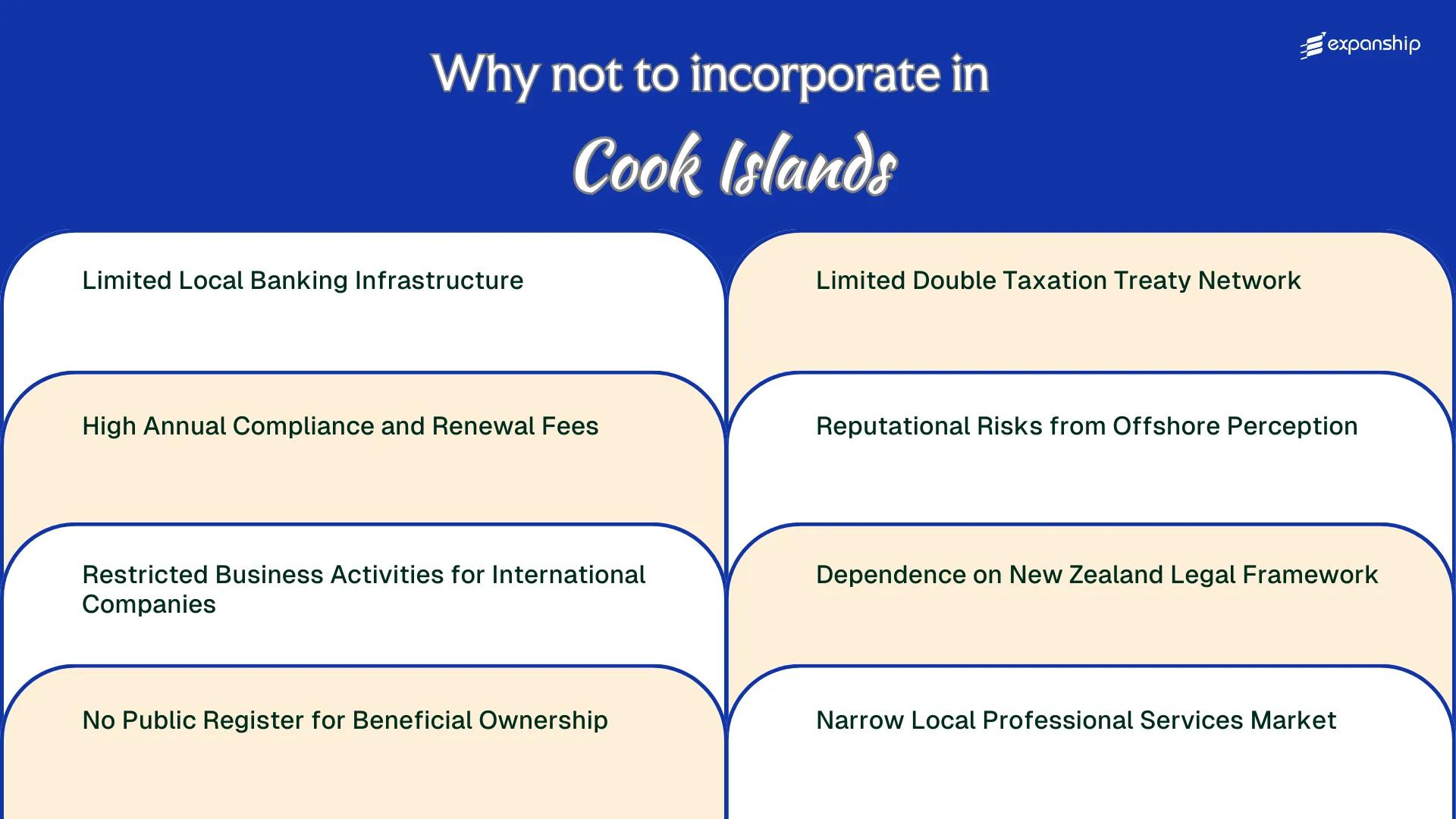
Limited Local Banking Infrastructure
Cook Islands banking infrastructure limitations affect foreign-owned companies from the moment of incorporation. Domestic banking options are sparse, and international banks apply heightened scrutiny to entities registered in offshore centers.
Restricted Access to Correspondent Banking
The Cook Islands has no major international banks with full-service branches. Most businesses incorporated under the International Companies Act 1981-82 find that local banks, primarily the Bank of the Cook Islands, do not readily extend commercial accounts to offshore entities, particularly those with no local economic activity. Your company may need to open accounts in New Zealand, Singapore, or another third jurisdiction, which adds complexity, time, and cost to basic treasury operations.
Offshore Label Triggers Compliance Barriers
Global correspondent banks apply enhanced due diligence to accounts linked to offshore Cook Islands companies, citing FATF and OECD compliance pressure. This means account applications for your entity face extended review periods and a higher rate of outright rejection compared to companies domiciled in onshore OECD jurisdictions. Some multi-currency payment platforms and fintech providers also restrict account eligibility based on incorporation address alone.
Foreign business owners should expect that opening a functional business bank account for a Cook Islands IBC may take several months and require third-country banking relationships, with no guarantee of approval.
High Annual Compliance and Renewal Fees
Cook Islands annual compliance fees drawbacks become apparent once you calculate the recurring costs of maintaining an International Business Company (IBC) registered under the International Companies Act 1981-82. Annual government renewal fees, registered agent fees, and mandatory local filing charges combine into a cost structure that exceeds what comparable offshore jurisdictions typically impose.
The Financial Supervisory Commission oversees ongoing compliance, and firms operating through Cook Islands structures must pay annual fees regardless of trading activity. A dormant entity generates the same baseline cost as an active one.
Practical burdens this fee structure creates for foreign business owners include:
- Paying renewal fees to both the government registry and a mandatory local registered agent, with no option to reduce cost by handling registration internally
- Absorbing annual charges even during years when the entity conducts no commercial transactions, eroding capital without generating returns
- Facing compounding costs if compliance deadlines are missed, as late penalties are added to the base renewal amount
The absence of a fee waiver mechanism for inactive entities means you bear full annual costs through the entire life of the company.

Company Incorporation in Cook Islands
Understand the full cost structure before registering a Cook Islands IBC, including government fees, registered agent requirements, and annual renewal obligations.
Restricted Business Activities for International Companies
Under the Cook Islands International Companies Act 1981-82, international companies are expressly prohibited from conducting business with residents or within the Cook Islands domestic market. Your entity is legally confined to operating exclusively outside the jurisdiction, which eliminates any possibility of generating local revenue or servicing clients based on the islands.
This restriction carries a direct operational consequence. If your business model requires any form of local service delivery, domestic client engagement, or on-island transactions, the international company structure is structurally incompatible with that model.
| Prohibited Activity | Restriction Type | Impact on Foreign Owner |
|---|---|---|
| Transacting with Cook Islands residents | Statutory prohibition | Entire domestic market is inaccessible |
| Holding Cook Islands real property directly | Ownership restriction | Local asset structuring requires additional entities |
| Conducting retail or service operations locally | Operational ban | No physical commercial presence permitted |
| Employing Cook Islands residents for local operations | Regulatory limitation | Staffing for local functions is restricted |
Banking, insurance, and financial services directed at the Cook Islands public are separately regulated and fall outside the scope of activities an international company can undertake without additional licensing. Obtaining those licenses involves distinct regulatory frameworks and bodies, adding cost and administrative complexity that many foreign firms do not anticipate at incorporation.
The permitted activity scope narrows further depending on the nature of your business. An offshore firm structured purely for holding, invoicing, or international trading may fit within the permitted framework, but any operational diversification toward local markets triggers compliance violations under the Act.
No Public Register for Beneficial Ownership
Cook Islands beneficial ownership transparency risks are a genuine compliance concern for any foreign business operating through an International Business Company (IBC) registered under the International Companies Act 1981-82. No publicly accessible register of beneficial owners exists, meaning third parties, banks, and counterparties cannot independently verify who controls a company.
This absence of public disclosure creates friction in cross-border commercial relationships. Foreign financial institutions increasingly require beneficial ownership verification as part of due diligence, and a structure that cannot produce a verifiable public record often triggers enhanced scrutiny or outright rejection.
The Financial Intelligence Unit holds compliance oversight responsibilities, but disclosure obligations run to the registered agent and relevant authorities, not to any public-facing registry. Your counterparties cannot self-serve this information.
- Beneficial ownership records are held privately by registered agents, not by a public authority
- Disclosure to regulators is required under anti-money laundering obligations, but not to commercial counterparties
- Foreign banks may demand supplementary ownership documentation before opening accounts for your IBC
- Cook Islands ownership disclosure limitations may conflict with transparency requirements imposed by your home jurisdiction
- Non-compliance with reporting obligations to the Financial Intelligence Unit carries statutory penalties under local AML legislation
Despite having no public beneficial ownership register, the Cook Islands shares financial intelligence with foreign regulators under international exchange agreements, meaning the structure is not invisible to foreign tax authorities.
Limited Double Taxation Treaty Network
Cook Islands double taxation treaty limitations present a structural gap that directly affects how your company is taxed on cross-border income.
Scope of the Treaty Gap
The Cook Islands has not concluded a broad network of bilateral double taxation treaties. Where most established offshore jurisdictions have signed agreements with major trade partners — Hong Kong, for instance, holds over 40 active DTTs — a Cook Islands entity generally cannot access treaty-reduced withholding tax rates on dividends, royalties, or interest paid from treaty countries.
Practical Consequences for Foreign Businesses
Without DTT coverage, income flowing through your structure from higher-tax jurisdictions may be subject to withholding at domestic statutory rates in the source country, creating a cost that treaty-resident entities would avoid. This limitation is particularly relevant if your business has counterparties or investment flows in jurisdictions with high default withholding rates. The absence of treaty protection cannot be resolved at the company level; it is a structural feature of operating under Cook Islands offshore tax agreement restrictions.
Addressing Structural Tax Gaps in Cook Islands Structures
Speak with our specialists about how limited DTT coverage affects your cross-border income flows and what structural considerations apply to your Cook Islands entity.
Reputational Risks from Offshore Perception
Cook Islands offshore reputational risks are among the most persistent drawbacks for businesses that incorporate there. The jurisdiction's longstanding classification as an offshore financial centre draws consistent scrutiny from banks, institutional partners, and regulatory bodies in higher-tax countries.
- Financial institutions in OECD member states frequently apply enhanced due diligence to entities registered in the Cook Islands, which can delay or block account opening entirely.
- The Global Forum on Transparency and Exchange of Information for Tax Purposes has historically flagged the jurisdiction's information-sharing practices, creating compliance exposure for your business partners abroad.
- Counterparties in the EU and UK may treat your firm's registered address as a red flag under their own internal anti-money laundering screening protocols.
- The tax haven perception problems associated with this jurisdiction can require your business to produce significantly more documentation to prove commercial substance than a company registered in a mainstream jurisdiction would.
- Correspondent banking relationships can be refused solely on the basis of jurisdiction of incorporation, regardless of your firm's actual ownership structure or activity.
Dependence on New Zealand Legal Framework
Cook Islands dependence on New Zealand law is a structural feature of the jurisdiction that carries real operational risk for foreign business owners. Under the Cook Islands Constitution Act 1964, New Zealand retains responsibility for the territory's defence and foreign affairs, and the two nations share a free association arrangement that has historically shaped the legal architecture here.
Domestic legislation draws heavily from New Zealand statutes, and local courts may reference New Zealand case law when gaps appear in Cook Islands jurisprudence. This means legal outcomes can be influenced by judicial decisions made in a foreign country, outside your direct visibility or input.
New Zealand influences on Cook Islands company risks extend to regulatory posture. When New Zealand tightens its stance on financial transparency or anti-money laundering compliance at the international level, that pressure can translate into corresponding amendments to local frameworks, including the Financial Supervisory Commission Act.
Your firm operates under a legal system that can shift in response to policy changes in Wellington, not just Avarua. That dependency limits the predictability any foreign investor relies on when making long-term structural decisions.
Hypothetical scenario: A foreign holding entity incorporated under the International Companies Act 1981-82 structures a 10-year asset protection arrangement. Midway through, New Zealand-aligned AML reforms require disclosure amendments to the local regulatory framework, triggering legal review costs of approximately USD 8,000-12,000 and a six-month restructuring period to restore intended confidentiality protections.
Narrow Local Professional Services Market
The Cook Islands professional services market limitations are a structural reality shaped by population size. The island group has a resident population of under 20,000, which directly constrains the number of qualified accountants, corporate lawyers, and licensed trust company operators available to service international entities.
Under the Cook Islands Companies Act 1970-71 and the framework administered by the Financial Supervisory Commission (FSC), international companies must work through licensed registered agents. The FSC-licensed agent pool is small, and concentration among a handful of providers creates capacity problems, particularly during peak filing periods tied to annual renewal cycles.
Limited local expertise in specialized areas, including cross-border tax structuring and multi-jurisdictional regulatory compliance, means that foreign business owners often must engage external counsel from New Zealand or other offshore financial centers to supplement what local providers can offer. This adds cost and coordination friction that would not exist in larger offshore centers such as the British Virgin Islands or Cayman Islands.
- Single-source dependency on one licensed agent creates operational risk if that provider ceases operations or loses its FSC license.
- Specialist advice on matters outside routine incorporation is generally not available locally at the required technical depth.
If your business requires specialized legal opinions, regulatory filings beyond standard company maintenance, or ongoing tax advisory work, you must budget for external professional fees outside the Cook Islands, as local capacity alone is unlikely to meet those requirements.
Overcoming Incorporation Challenges in Cook Islands
Overcoming Cook Islands incorporation challenges requires a structured approach grounded in the jurisdiction's actual regulatory and legal framework, not workarounds that ignore it.
- Engage a licensed trustee company registered under the Cook Islands Financial Supervisory Commission to maintain your IBC's registered office and ensure annual compliance filings are met on schedule.
- Account for the absence of a comprehensive double taxation treaty network by structuring your entity's activities to align with jurisdictions that have independent treaty access.
- Mitigate correspondent banking friction by establishing relationships with New Zealand-based banks that maintain operational ties to the Cook Islands, given the shared currency and financial linkages.
- Address reputational exposure by maintaining auditable records of commercial substance and purpose, consistent with the international transparency standards the FSC endorses.
- Plan for restricted business activity categories by confirming permitted operations under the International Companies Act 1981-82 before committing to a specific corporate structure.
These steps operate within the boundaries set by the FSC and the International Companies Act. The framework does not eliminate structural constraints, but working within it systematically reduces the compliance exposure that offshore entities face.
Cook Islands Incorporation Still Worth It
The Cook Islands carries real disadvantages as an incorporation destination — limited banking access, a narrow treaty network, and persistent reputational scrutiny are not minor frictions. Yet for businesses that have assessed Cook Islands incorporation worth it despite risks, the jurisdiction's strong asset protection legislation under the International Companies Act 1981-82 and its established trust law framework continue to draw legitimate international use.
| Pro | Con |
|---|---|
| Strong statutory asset protection under the International Companies Act 1981-82 | No public beneficial ownership register increases scrutiny from foreign regulators |
| Established offshore legal framework with decades of precedent | Limited double taxation treaty network reduces treaty-based tax planning options |
| No local corporate tax on foreign-sourced income for qualifying international companies | High annual renewal and compliance fees relative to comparable offshore jurisdictions |
| Legal system anchored in New Zealand common law principles | Dependence on New Zealand's legal framework limits autonomous legislative development |
| Recognised jurisdiction for international trust and asset structuring | Narrow local professional services market constrains on-the-ground support options |
Your business profile determines whether these trade-offs are acceptable. The structural benefits are real, but so are the compliance costs and banking constraints.
Compliance Services for Companies in the Cook Islands
Maintain your Cook Islands international company in good standing with annual filing, renewal, and regulatory compliance support.
Conclusion
The Cook Islands offshore incorporation cons overview is not easily dismissed — the jurisdiction carries a defined set of structural limitations that affect how your company can operate, bank, and be perceived internationally. The absence of a bilateral tax treaty network restricts legitimate tax planning across most jurisdictions, while the narrow local banking infrastructure creates persistent account-opening difficulties. Reputational exposure tied to offshore classification remains a practical concern regardless of the entity's underlying purpose. For businesses where these constraints are material, specialist legal and fiduciary guidance becomes a prerequisite rather than an option.
Expanship Supports Your Cook Islands Expansion
From the International Companies Act 1981-82 to the Financial Supervisory Commission's ongoing compliance requirements, Cook Islands company formation support challenges are real and operationally demanding. Expanship works alongside your business to manage the administrative weight of these obligations, including annual renewal filings, registered agent requirements, and the coordination that offshore IBC structures typically demand.
Beyond those specifics, Expanship offers a full range of corporate services for businesses establishing a presence in the Cook Islands:
- Your company is registered and all formation documents are prepared to the Financial Supervisory Commission's standards.
- A local registered agent and registered office address are provided to satisfy statutory requirements.
- Government filings are handled and direct liaison with the relevant regulatory bodies is maintained on your behalf.
- Post-incorporation compliance is monitored to keep your entity in good standing year after year.
- Banking introductions are facilitated to help your business establish a functional account relationship.
- Tax registration and coordination with local authorities is managed as part of your setup.
Reach out to Expanship Cook Islands to discuss how we can support your incorporation process.
Frequently Asked Questions (FAQ)
It affects any Cook Islands entity with cross-border income flows, though the practical impact varies by income type. The Cook Islands has signed very few comprehensive double taxation agreements, meaning dividends, royalties, and interest paid from higher-tax jurisdictions to a Cook Islands entity are often subject to full withholding tax at source with no treaty reduction available. Businesses with significant royalty or dividend streams will feel this gap most acutely.
Failure to meet annual renewal requirements under the Cook Islands International Companies Act 1981-82 can result in the company being struck off the register maintained by the Financial Supervisory Commission. Reinstatement is possible but involves additional fees and administrative delays. Operating while struck off also exposes directors and shareholders to potential personal liability.
It is both. While the Cook Islands does not maintain a publicly accessible beneficial ownership register, the Financial Supervisory Commission does hold ownership information under confidentiality provisions, and foreign authorities can request disclosure through formal legal assistance channels. If your business operates in a jurisdiction that requires beneficial ownership transparency, such as an EU member state, the structural opacity of a Cook Islands entity may trigger regulatory scrutiny or compliance obligations in that country regardless of local Cook Islands law.
The Cook Islands legal system draws heavily from New Zealand common law, which means gaps in local legislation are filled by reference to New Zealand precedents and principles. While this provides a degree of legal predictability, it also means local jurisprudence is thin and disputes may require costly legal interpretation by specialists familiar with both systems. For businesses expecting straightforward local court resolution of commercial matters, the limited depth of the Cook Islands judiciary can be a practical constraint.
For most corporate service needs, yes. The Cayman Islands and British Virgin Islands both have significantly larger ecosystems of auditors, corporate lawyers, and compliance professionals with international firm affiliations. The Cook Islands market is smaller, meaning fewer service provider options, less competitive pricing in some specialist areas, and potential capacity constraints if demand increases or your matter becomes complex.
No. An International Business Company incorporated under the Cook Islands International Companies Act 1981-82 is explicitly restricted from conducting business with Cook Islands residents or owning local real property as a core condition of its tax-exempt status. Attempting to conduct domestic activities breaches the terms under which the entity was incorporated and can result in loss of tax-exempt status and regulatory action by the Financial Supervisory Commission.
Legal Disclaimer
The information provided in this article is for general informational purposes only and does not constitute legal, tax, or professional advice. While we strive to ensure the accuracy and timeliness of the content, laws and regulations are subject to change, and the application of laws can vary widely based on specific facts and circumstances.
Readers should not act upon this information without seeking professional counsel tailored to their individual situation. Expanship and its authors disclaim any liability for actions taken or not taken based on the content of this article.
For specific advice regarding your business setup, compliance requirements, or any legal matters, please consult with qualified legal and tax professionals in the relevant jurisdiction.