
Key Takeaways
- OHADA membership gives your entity access to a unified commercial legal framework enforced across 17 member states, materially reducing the legal uncertainty that typically accompanies cross-border operations in Central Africa.
- The SARL structure caps investor liability at the level of their capital contribution while maintaining accessible formation thresholds, separating personal assets from business risk without imposing prohibitive setup costs.
- Bilateral investment treaties in force provide treaty-backed protections against arbitrary state action, giving foreign shareholders a formal legal recourse mechanism that operates independently of domestic courts.
- Congo's Investment Code unlocks sector-specific tax exemptions and incentive periods that can be structured into your entry plan from incorporation, reducing the effective cost of establishing a formal commercial presence.
Situated on the western coast of Central Africa, the Republic of the Congo is a sovereign nation bordered by Gabon, Cameroon, the Central African Republic, the Democratic Republic of the Congo, and Angola. Company registration falls under the authority of the GUICHET UNIQUE, the one-stop shop established to centralize business formalization procedures in the country. Foreign investors typically incorporate through the Société à Responsabilité Limitée as their primary legal vehicle.
The benefits of incorporating in Republic of the Congo draw interest from investors across extractive industries, trade, and services, given the country's territorial tax posture and its general openness to foreign direct investment under its Investment Code. Foreign nationals may hold full ownership in most sectors without mandatory local partnership requirements. This article examines the key advantages your business can access by establishing a formal presence here.
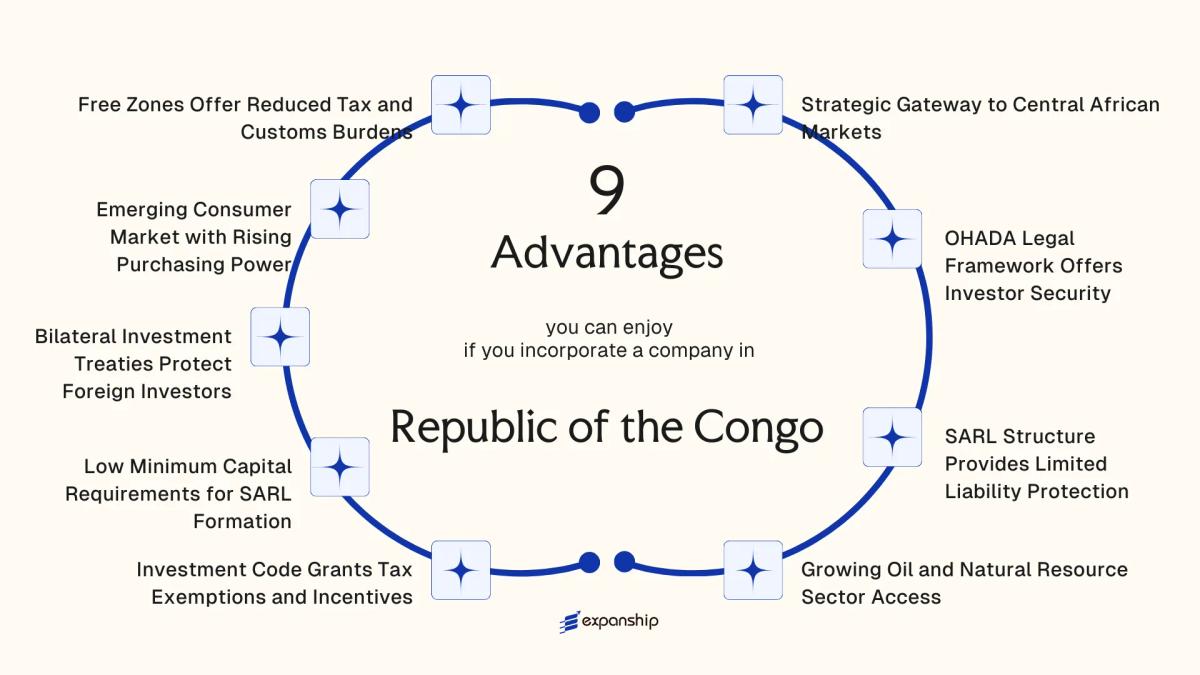
Strategic Gateway to Central African Markets
Brazzaville sits at the geographic center of the Congo Basin, positioning the Republic of the Congo Central Africa market access story around one of the continent's most connected transit corridors. The country shares borders with Gabon, Cameroon, the Central African Republic, the Democratic Republic of Congo, and Angola.
Rail, River, and Road Corridors
The Congo-Ocean Railway connects Brazzaville to the deep-water port of Pointe-Noire, the principal commercial port on the Atlantic coast. For a foreign business distributing goods across Central Africa, this corridor reduces dependence on landlocked routing and cuts transit times to coastal export points significantly.
The Congo River itself forms a natural freight artery linking Brazzaville directly to Kinshasa, the largest city in sub-Saharan Africa by population. That proximity gives your business access to a metropolitan economy of over 15 million people across a short river crossing.
CEMAC Membership and Regional Trade
As a member state of the Economic and Monetary Community of Central Africa (CEMAC), the country participates in a common external tariff framework covering six nations. Goods produced or processed within the CEMAC zone circulate under preferential conditions, which reduces the customs friction your entity would otherwise face when supplying regional markets.
A company registered in Brazzaville can serve both CEMAC member states and DRC markets from a single operational base.
OHADA Legal Framework Offers Investor Security
The OHADA legal framework investor protection Congo provides is one of the more structurally significant advantages available to foreign companies entering this market. The Organisation pour l'Harmonisation en Afrique du Droit des Affaires — OHADA — unifies commercial law across 17 member states through a set of directly applicable Uniform Acts. These acts govern company formation, commercial contracts, secured transactions, insolvency, and arbitration, removing the need to interpret a patchwork of national statutes.
For your business, this means the legal environment is predictable from day one. A French, British, or American legal counsel familiar with OHADA Uniform Acts can advise on obligations without extensive re-training in local law, reducing due diligence costs and legal uncertainty.
The OHADA Treaty also established the Common Court of Justice and Arbitration (CCJA), seated in Abidjan, which provides a supranational dispute resolution mechanism. Investor security under OHADA in Congo Brazzaville is therefore not dependent solely on domestic courts.
Several structural features make this framework particularly favourable:
- Contract enforcement draws on a standardised body of law, not discretionary national interpretation
- Arbitral awards issued under the CCJA are enforceable across all OHADA member states
- The Uniform Act on Commercial Companies sets clear rules on shareholder rights and director liability
- Regular OHADA treaty revisions reflect evolving commercial practice, keeping the framework current

Company Incorporation in the Republic of the Congo
Register your business in the Republic of the Congo with structured guidance on OHADA-compliant entity formation and ongoing compliance requirements.
SARL Structure Provides Limited Liability Protection
Under the OHADA Uniform Act on Commercial Companies and Economic Interest Groups (AUSCGIE), a Société à Responsabilité Limitée caps each shareholder's financial exposure at the level of their individual capital contribution. The SARL limited liability benefits Republic of the Congo investors gain from this structure are grounded in supranational treaty law, not domestic discretion, which means the protection cannot be altered unilaterally by local legislation.
For a foreign business owner, this distinction carries real weight. Your personal assets, held outside the company, remain legally separate from any commercial debts or contractual obligations the entity incurs. If the firm encounters insolvency, creditors have no claim beyond the company's own assets.
| Feature | Detail |
|---|---|
| Governing instrument | OHADA AUSCGIE |
| Shareholder liability | Limited to capital contribution |
| Minimum shareholders | 1 |
| Maximum shareholders | 100 |
| Personal asset exposure | None beyond subscribed capital |
Congo Brazzaville SARL liability protection for investors applies from the moment the entity is registered with the Centre de Formalités des Entreprises. A single-member SARL, known as a SARLU, extends the same protection to sole founders. The liability ceiling holds regardless of whether shareholders are resident nationals or foreign nationals, making the structure functionally consistent across ownership configurations.
One condition applies: courts can pierce the corporate veil if a shareholder is found to have commingled personal and company funds or acted in bad faith, a standard that exists across most OHADA member states.
Growing Oil and Natural Resource Sector Access
Petroleum dominates the Republic of the Congo oil sector investment benefits conversation for a clear reason: hydrocarbons consistently account for over 60% of government revenues and roughly 70% of export earnings. For a foreign investor, that concentration signals a mature extraction economy with established infrastructure, defined regulatory pathways, and a government structurally motivated to maintain upstream activity.
The regulatory authority overseeing the sector is the Ministère des Hydrocarbures, which administers exploration and production licenses under the 2016 Hydrocarbons Code. This legislation defines the terms for Production Sharing Agreements (PSAs) between the state oil company SNPC (Société Nationale des Pétroles du Congo) and foreign operators. PSAs allow your firm to participate in upstream activity while limiting exposure to direct asset ownership risk.
Beyond oil, the country holds meaningful deposits of potash, iron ore, and timber, creating entry points for firms in mining and commodity logistics.
Key points to keep in mind:
- PSA terms are negotiated with SNPC and require Ministère des Hydrocarbures approval
- The 2016 Hydrocarbons Code sets fiscal terms, including cost recovery ratios
- Foreign equity participation thresholds may apply depending on block classification
- Local content provisions under the Code require defined levels of Congolese employment and subcontracting
Congo Brazzaville's offshore Moho-Nord field, operated by TotalEnergies, produces from depths exceeding 750 meters, making it one of the deepest active deepwater projects in sub-Saharan Africa.
Investment Code Grants Tax Exemptions and Incentives
The Republic of the Congo investment code tax exemptions represent one of the more tangible financial advantages available to foreign investors entering the country. Under Law No. 6-2012 on the Investment Charter, qualifying businesses can access structured tax incentives tied to the sector of activity, the size of the investment, and the geographic location of operations. For a foreign firm calculating the real cost of market entry, these incentives directly reduce the tax burden during the earliest and most capital-intensive years of operation.
Phased Tax Holidays Reduce Early-Stage Costs
The Investment Charter establishes multiple incentive regimes, with tax holidays that can extend across an initial period of operations for eligible enterprises. Businesses operating in priority sectors, such as agribusiness, manufacturing, and services outside the extractive industries, may benefit from full or partial exemptions on corporate income tax, import duties on capital equipment, and certain registration fees. This front-loaded relief means your firm retains more working capital at the stage when cash flow is most constrained.
Eligibility typically depends on meeting defined investment thresholds and creating local employment. Firms that commit to specific spending levels and local hiring benchmarks qualify for longer exemption periods under the charter's provisions.
Customs Relief Supports Capital Equipment Imports
For businesses requiring significant physical infrastructure, partial or full customs duty exemptions on imported equipment substantially lower initial setup costs. This provision applies to qualifying capital goods used directly in production or service delivery.
The practical effect is that your entity avoids a layer of upfront costs that would otherwise be unavoidable in markets without such treaty-backed protections.
Maximize Your Tax Incentive Eligibility in the Republic of the Congo
Expanship's specialists can assess your business structure against the Investment Charter's eligibility criteria and help you identify which exemption regimes apply to your specific sector and investment size.
Low Minimum Capital Requirements for SARL Formation
Under the OHADA Uniform Act on Commercial Companies, a Société à Responsabilité Limitée (SARL) can be formed with a minimum share capital of XAF 100,000 (approximately USD 160). This threshold is set by OHADA's supranational commercial law framework, which governs business formation across all 17 member states, including the Republic of the Congo.
For a foreign business owner, this low entry point has a direct practical consequence: you can legally establish a locally incorporated entity, open a corporate bank account, sign contracts, and employ staff without committing significant capital at the formation stage. That capital can instead be directed toward operations, licensing, or market development.
- The XAF 100,000 minimum applies at registration and does not require full deposit into a blocked account before incorporation is complete, reducing the administrative lead time before your business becomes operational.
- Because OHADA sets this threshold uniformly, the rule is predictable and not subject to unilateral changes by national Congolese legislation, giving your formation structure a degree of regulatory stability.
- No minimum paid-up ratio is mandated for SARLs at formation under the current OHADA framework, meaning shareholders retain flexibility in how and when capital contributions are made after registration.
Bilateral Investment Treaties Protect Foreign Investors
The bilateral investment treaties Republic of the Congo has signed give foreign investors a formal, enforceable layer of protection that sits above domestic law. These treaties typically guarantee fair and equitable treatment, protection against expropriation without compensation, and access to international arbitration if a dispute arises with the Congolese state.
Your business is not limited to local courts to resolve investment disputes. Where a treaty includes investor-state dispute settlement (ISDS) provisions, you can bring claims before international arbitral tribunals such as ICSID, bypassing domestic judicial processes entirely. That procedural access reduces the risk exposure that often deters foreign capital in emerging markets.
Congo Brazzaville BIT protection extends to nationals of treaty partner countries who hold qualifying investments in the territory. The specific protections available to your firm depend on which treaty applies based on your nationality, so treaty coverage should be verified against the applicable bilateral agreement before structuring your investment.
A hypothetical scenario: A European manufacturing firm incorporated in the Republic of the Congo under a bilateral treaty with ISDS provisions faces a regulatory reversal that effectively nullifies its operational license. Rather than pursuing redress through domestic courts over an extended timeline, the firm files for international arbitration, potentially recovering damages within a defined procedural framework that domestic litigation cannot guarantee.
Emerging Consumer Market with Rising Purchasing Power
Brazzaville and Pointe-Noire are home to an urbanizing population where formal employment in the oil and services sectors has steadily expanded household incomes over the past decade. This shift in purchasing behavior creates direct demand for consumer goods, financial services, retail, and hospitality — categories where foreign firms can enter with limited local competition.
Urban consumers in the Republic of the Congo show increasing preference for imported goods and branded services, a pattern consistent with rising disposable income in oil-dependent economies. For a foreign business entering the market early, this preference reduces the barrier to brand recognition.
The country's population skews young, with a median age under 20, which means a structurally growing consumer base over the coming years. Businesses that establish a legal presence now can build distribution networks and supplier relationships before the market matures.
- Consumer spending is concentrated in Brazzaville and Pointe-Noire, allowing targeted market entry without nationwide infrastructure
- The services sector, including telecoms and banking, is underpenetrated relative to urban population size
- Demand for processed food, packaged goods, and retail is driven by urbanization rates exceeding 67%
Market access advantages apply primarily to firms establishing a physical or registered presence in-country; foreign entities operating without local incorporation may face restrictions under Congo's commercial licensing rules.
Free Zones Offer Reduced Tax and Customs Burdens
The Republic of the Congo free zones tax benefits are grounded in the country's Special Economic Zone framework, which establishes designated areas where businesses operating in qualifying sectors face substantially reduced fiscal obligations. The Pointe-Noire Special Economic Zone (ZES) is the primary such area, positioned adjacent to the country's main deepwater port.
Customs Duty Exemptions
Firms registered within the ZES are generally exempt from import duties on raw materials, machinery, and equipment used in production. For a manufacturing or processing entity that depends on imported inputs, this directly reduces capital expenditure and operating costs from the outset. These exemptions apply for a fixed period as defined by the applicable zone regulations, rather than indefinitely.
Reduced Corporate Tax Exposure
Businesses operating within designated free zones benefit from preferential corporate income tax rates compared to the standard regime that applies to domestic firms. This differential creates a measurable cost advantage for foreign-owned companies that structure their Congolese operations to qualify under zone conditions.
Conditions for Zone Benefits
Eligibility typically requires that your business conduct a defined category of economic activity, such as export-oriented manufacturing, logistics, or processing. The following criteria generally apply to zone-registered entities:
- Physical establishment within the designated zone perimeter
- Compliance with minimum investment or employment thresholds
- Goods or services must meet export percentage requirements
Meeting these conditions grants access to a tax environment that differs materially from what applies to general commercial entities registered under the standard Investment Code.
Why the Republic of the Congo Stands Out Regionally
The Republic of the Congo regional business advantages become clearer when placed alongside the jurisdictions that foreign investors most commonly evaluate in parallel. Cameroon, Gabon, and the Democratic Republic of the Congo share geographic proximity and broadly similar incorporation profiles, making them the most relevant comparators for a business weighing Central African market entry. What the comparison reveals is not simply a matter of cost, but of legal predictability, incentive structure, and treaty coverage.
All four jurisdictions operate under OHADA, which levels the legal playing field significantly. Where differentiation emerges is in the specific application of investment codes, free zone frameworks, and bilateral treaty networks. Congo Brazzaville's Investment Charter, combined with its Special Economic Zone regime, positions it alongside Gabon as one of the more structured incentive environments in the sub-region, rather than among jurisdictions where incentives remain largely discretionary.
| Parameter | Republic of the Congo | Gabon | Cameroon | DR Congo |
|---|---|---|---|---|
| Governing Business Law | OHADA Uniform Acts | OHADA Uniform Acts | OHADA Uniform Acts | OHADA Uniform Acts |
| Investment Code Framework | Yes (Law No. 6-2012) | Yes (Investment Charter) | Yes (Investment Charter) | Yes (Investment Code) |
| Special Economic Zones | Yes (Pointe-Noire SEZ) | Yes (Nkok SEZ) | Limited | Limited |
| Minimum Capital for SARL | Symbolic (OHADA standard) | Symbolic (OHADA standard) | Symbolic (OHADA standard) | Variable |
| Bilateral Investment Treaties | Yes (multiple) | Yes (multiple) | Yes (multiple) | Yes (multiple) |
| Corporate Tax Rate | 28% | 30% | 33% | 35% |
Compliance Services for Companies in the Republic of the Congo
Stay aligned with Congo Brazzaville's regulatory requirements, from annual filings to tax obligations and statutory reporting under OHADA and local law.
Conclusion
The benefits of incorporating in Republic of the Congo are most evident when examined through the lens of legal security, resource access, and fiscal structure. OHADA membership gives your entity a codified commercial framework enforced across 17 member states, reducing legal uncertainty in ways that matter operationally. Combined with the investment incentives available under the national Investment Code, a foreign firm can structure its entry with meaningful cost advantages from the outset.
Two factors carry particular weight for investors assessing this jurisdiction. The SARL's limited liability structure protects personal assets while keeping formation requirements accessible, and the bilateral investment treaties in force provide a formal layer of protection against arbitrary state action. These are not incidental features; they are the structural foundation on which a viable foreign business presence can be built.
Suitability varies by sector and business model. A firm targeting natural resource supply chains operates in a different regulatory environment than one entering retail or services, and the incentives available under special economic zones or sector-specific codes will apply differently in each case. Understanding which provisions apply to your specific activity determines how much of this framework you can actually use.
The case for this jurisdiction rests on the convergence of a defined legal order, treaty-backed investor protections, and an economy with commodity-driven growth creating downstream commercial demand. For businesses whose objectives align with those conditions, formalising a structure here is a measurable next step.
Start Your Congo Company Formation with Expanship Today
Expanship Congo company formation services cover the full incorporation cycle for foreign investors establishing a Société à Responsabilité Limitée or Société Anonyme in Brazzaville. From initial structuring through registration with the Centre de Formalités des Entreprises (CEFORE) and compliance with OHADA Uniform Acts, the process involves multiple coordinated steps that carry real administrative and legal consequence if mishandled.
Expanship handles each stage directly, so your entity is registered correctly from the outset:
- Preparation and legalization of incorporation documents, including statutes and identity documentation
- Registered agent and registered office provision for your entity in Brazzaville
- Government filing and liaison with CEFORE and relevant public registries
- Post-incorporation compliance management, including annual reporting obligations
- Banking introduction assistance to support your firm's operational setup in-country
Expanship Congo is available to discuss your incorporation requirements directly.
Frequently Asked Questions (FAQ)
Yes, foreign nationals can hold 100% ownership of a Société à Responsabilité Limitée (SARL) under the OHADA Uniform Act on Commercial Companies. The OHADA framework, which the Republic of the Congo adopted, does not impose mandatory local shareholding requirements for most commercial entities. Certain regulated sectors, including hydrocarbons and some concession-based industries, may carry additional ownership conditions under sector-specific legislation, so you should verify requirements against the applicable sectoral law before structuring your entity.
Under the revised OHADA Uniform Act on Commercial Companies and Economic Interest Groups, the minimum share capital for a SARL is 1 franc CFA, effectively removing a meaningful capital threshold for most formations. This applies uniformly across OHADA member states, including Congo Brazzaville. Regulated industries may impose their own capitalization requirements separately from the OHADA baseline.
The Investment Code grants qualifying businesses exemptions or reductions on corporate income tax, customs duties, and certain indirect taxes during an initial operating period. The duration and scope of these benefits depend on the investment tier the firm qualifies for, determined by factors such as capital invested and sector of activity. Applications for Investment Code status are processed through the designated investment promotion authority rather than automatically granted at incorporation.
Registration through the Centre de Formalités des Entreprises (CFE), the one-stop shop for business formation, is designed to consolidate procedures that previously required multiple agencies. In practice, timelines vary depending on document completeness and current administrative capacity, but formal registration can be completed within a matter of days when all notarized documents and required filings are in order. Delays most commonly arise from apostille requirements on foreign documents or outstanding notarial steps.
Bilateral investment treaties (BITs) to which the Congo is a signatory provide enforceable protections including fair and equitable treatment, protection against expropriation without compensation, and access to international arbitration, typically through ICSID. These protections are binding under international law and can be invoked independently of domestic courts. The specific arbitration mechanisms and standards available to your business depend on the BIT between the Congo and your home country, so identifying the applicable treaty before structuring your investment is advisable.
A SARL incorporated under OHADA is subject to ongoing obligations including annual financial statement preparation, filing with the Registre du Commerce et du Crédit Mobilier (RCCM), and convening annual general meetings of associates. The OHADA Uniform Act on Accounting Law (SYSCOHADA) governs financial reporting standards applicable to the entity. Failure to maintain these obligations can affect the company's legal standing and, in some circumstances, expose managers to personal liability under OHADA provisions.
Free zone entities are generally established to serve export markets, and selling into the domestic market is either restricted or subject to standard import duties and taxes as if the goods had entered from abroad. The precise conditions governing domestic sales from a free zone depend on the enabling legislation and concession agreement governing the specific zone. If your business model requires both export activity and domestic distribution, a dual-structure approach may be necessary, with separate entities or licensing arrangements to cover each market.
Legal Disclaimer
The information provided in this article is for general informational purposes only and does not constitute legal, tax, or professional advice. While we strive to ensure the accuracy and timeliness of the content, laws and regulations are subject to change, and the application of laws can vary widely based on specific facts and circumstances.
Readers should not act upon this information without seeking professional counsel tailored to their individual situation. Expanship and its authors disclaim any liability for actions taken or not taken based on the content of this article.
For specific advice regarding your business setup, compliance requirements, or any legal matters, please consult with qualified legal and tax professionals in the relevant jurisdiction.