

Key Takeaways
- Wholly foreign-owned entities are permitted in most sectors under Burundi's legal framework, removing a structural barrier that limits foreign investor control in many comparable African jurisdictions.
- Burundi's membership in the East African Community grants registered entities preferential access to a regional market that extends well beyond the country's domestic consumer base.
- The Investment Code provides codified protections for foreign investors, meaning that guarantees against arbitrary treatment are grounded in a specific legal instrument rather than administrative discretion.
- At a standard corporate income tax rate of 30%, combined with a materially lower operating cost base than most EAC peers, Burundi offers a cost structure that directly affects the commercial viability of priority-sector investments.
Burundi is a landlocked sovereign republic in the Great Lakes region of Central-East Africa, bordering Tanzania, Rwanda, and the Democratic Republic of Congo. The primary regulatory authority overseeing business registration is the API — the Agence de Promotion des Investissements — which operates as the official investment promotion and company registration body. Foreign businesses entering the market typically do so through a Société à Responsabilité Limitée.
The country applies a standard corporate tax regime rather than a zero-tax or purely territorial model, with rates and incentive structures governed by the national investment code. On the question of foreign ownership, the legal framework does not impose a blanket restriction on foreign shareholding, and wholly foreign-owned entities are permitted in most sectors.
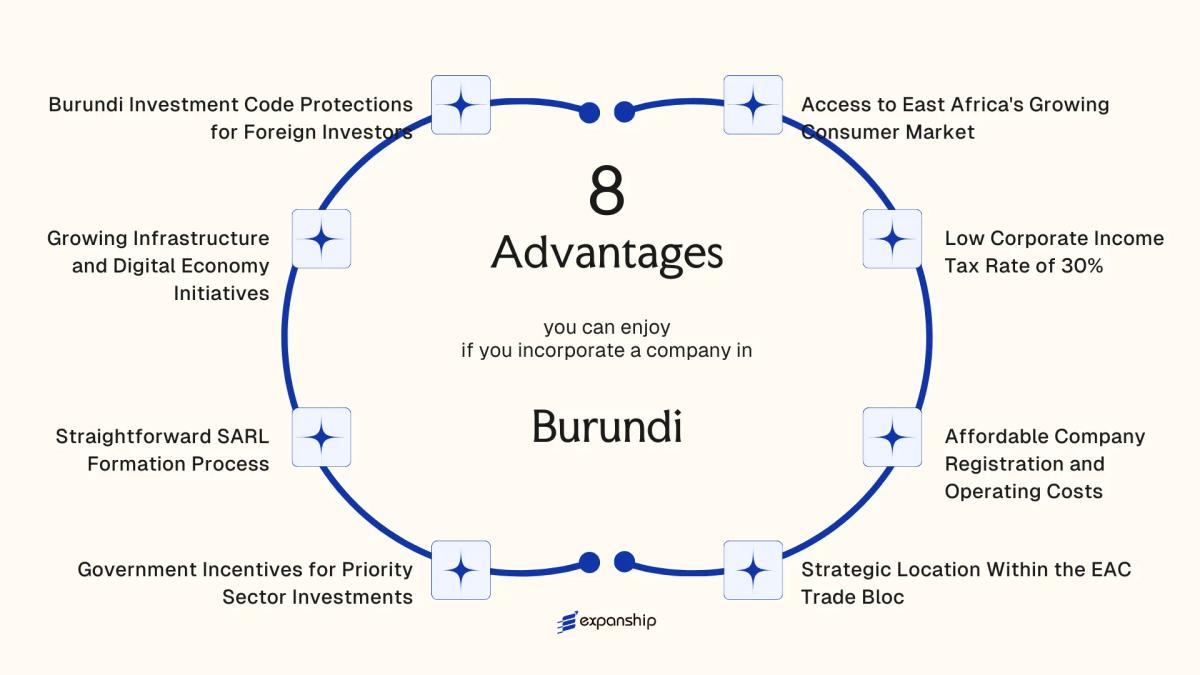
The benefits of incorporating in Burundi span market access, cost structures, regulatory protections, and sectoral incentives. This article examines the key Burundi company formation advantages that make the jurisdiction a subject of practical interest for businesses considering an East African presence.
Access to East Africa's Growing Consumer Market
Burundi access to East Africa consumer market is shaped primarily by the country's membership in the East African Community (EAC), a regional bloc whose combined population exceeds 300 million people. Incorporated entities operating from within the bloc benefit from preferential trade arrangements that reduce friction on cross-border commerce.
Trading Under EAC Protocols
The EAC Customs Union Protocol, in force since 2005, eliminates internal tariffs on qualifying goods traded between member states, which include Kenya, Tanzania, Uganda, Rwanda, and the Democratic Republic of Congo. Your business can distribute products across these markets without facing the full duty burden that applies to firms incorporated outside the bloc.
The EAC Common Market Protocol further extends this by covering the free movement of services and capital among member states. This means a firm registered in Burundi can enter East Africa market entry agreements with regional partners under a legally recognized framework, rather than negotiating separate bilateral arrangements.
What Preferential Access Means in Practice
Expanding into East Africa via Burundi gives your entity a compliant, treaty-backed foothold rather than a purely offshore structure. Regional market advantages for businesses stem directly from these binding protocols, not discretionary government policy.
EAC membership gives your registered entity treaty-level trade access across six member state markets without additional bilateral negotiations.
Low Corporate Income Tax Rate of 30%
Burundi's standard corporate income tax rate sits at 30%, governed under the country's General Tax Code administered by the Office Burundais des Recettes (OBR). For foreign investors assessing entry into the East African market, this rate represents a defined, predictable liability rather than an ambiguous or variable burden.
At 30%, the rate is broadly consistent with the East African Community regional norm, which matters because it removes the risk of your business facing a punitive outlier rate while still operating within a tax framework that regional accountants and advisors understand well.
Predictability itself carries practical value. When your entity can model tax exposure with a fixed statutory rate from the outset, financial planning becomes more straightforward, particularly for businesses in early operational phases where cash flow management is a priority.
The General Tax Code also provides a structured basis for calculating taxable income, meaning the rules governing deductions and assessable profits are codified rather than left to administrative discretion. This gives your firm a defined framework within which to structure its accounts.
Conditions apply: certain priority sectors may qualify for reduced rates or temporary exemptions under the Investment Code, but the 30% rate serves as the baseline for standard commercial activity.
- The OBR administers tax collection through a centralised process, reducing the number of agencies your business must engage
- Taxable income rules are codified, so deductible expenses follow a documented framework rather than informal interpretation
- The rate applies uniformly to resident companies, giving foreign-owned entities the same statutory baseline as locally owned firms

Company Incorporation in Burundi
Establish your company in Burundi with full compliance support from entity selection through to OBR registration.
Affordable Company Registration and Operating Costs
Affordable business operating costs in Burundi give foreign investors a meaningful structural advantage that begins before operations even start. Registering a Société à Responsabilité Limitée (SARL) through the Agence de Promotion des Investissements (API) involves a minimum share capital requirement of BIF 100,000, which is a modest threshold by regional standards. Combined with government fees that remain lower than many comparable African jurisdictions, the initial outlay to establish a legal entity is contained from the outset.
| Cost Factor | Detail |
|---|---|
| Minimum share capital (SARL) | BIF 100,000 |
| Company registration authority | Agence de Promotion des Investissements (API) |
| Office rental market | Generally lower cost than Nairobi or Kigali |
| Labour cost profile | Among the lower wage markets within the EAC |
Once operational, your firm benefits from a wage structure that reflects the country's labour market conditions. Average salaries across most sectors remain below those in neighbouring Kenya and Rwanda, which directly reduces recurring payroll obligations without requiring any special dispensation or negotiated arrangement.
Commercial lease costs in Bujumbura are also comparatively contained relative to other East African capital cities. For businesses that require a physical office to satisfy local presence requirements under the OHADA-aligned corporate framework, this translates into lower fixed overhead on an ongoing basis.
Strategic Location Within the EAC Trade Bloc
Burundi's position within the East African Community creates a structural trade advantage that is written into treaty law, not merely geographic circumstance. As a founding member of the EAC, your company incorporated here operates under the EAC Customs Union Protocol, which eliminates customs duties on qualifying goods traded between member states including Kenya, Tanzania, Uganda, Rwanda, and the Democratic Republic of Congo.
Under the EAC Common External Tariff, goods manufactured or substantially transformed within the bloc can move across member state borders without attracting internal tariffs. For a firm producing goods locally and distributing regionally, this directly reduces landed costs in each destination market.
The EAC Customs Union Protocol also establishes rules of origin requirements, meaning your products must meet defined local content or transformation criteria to qualify for preferential treatment. This is a practical threshold to plan around during entity setup.
Keep these points in mind:
- Confirm your goods meet EAC rules of origin criteria before structuring supply chains
- Register with the Burundi Revenue Authority (OBR) to access documented preferential trade status
- Verify that your product category falls within the EAC Common External Tariff Schedule
- DRC's EAC membership is recent; its full integration into preferential trade arrangements is still being phased in
Burundi is one of the smallest economies in the EAC by GDP, yet its geographic position borders three member states simultaneously, giving it more land-border trade access points relative to its size than most bloc members.
Government Incentives for Priority Sector Investments
Burundi government incentives for foreign investors are codified under the Investment Code of 2008 (revised), administered by the API (Agence de Promotion des Investissements). Rather than applying uniformly across all industries, the incentive structure is tiered, meaning your firm's eligibility and benefit level depend directly on which sector it operates in and where it is located.
Sector-Based Tax Exemptions
Agriculture, agro-processing, tourism, manufacturing, and export-oriented services are designated priority sectors under the Investment Code. Businesses operating in these areas can qualify for corporate tax holidays and customs duty exemptions on imported capital equipment, which directly reduces the upfront cost of establishing productive operations.
Qualifying entities in less-developed provinces may access enhanced exemption periods compared to those established in Bujumbura, reflecting the government's policy of directing capital toward underserved regions.
Minimum Investment Thresholds and API Registration
Accessing these Burundi investment promotion benefits requires formal registration with the API and meeting minimum capital thresholds, which vary by sector classification. This registration process is what triggers the legal entitlement to incentives, not merely operating in a priority industry.
For export-focused businesses, incentives can include reduced withholding tax on repatriated profits, which has a direct effect on after-tax returns for foreign shareholders. The benefit is structural: your tax position is determined at the point of registration, giving you cost certainty before operations begin.
Maximize Your Incentive Eligibility in Burundi
Speak with our team to identify which priority sector incentives apply to your business structure and how to register correctly with the API.
Straightforward SARL Formation Process
Forming a société à responsabilité limitée is one of the more accessible entry points for foreign capital in the region, and the Burundi SARL formation advantages for investors begin with the relatively low administrative threshold to establish the structure. Under Burundian company law, an SARL can be formed with a single shareholder, removing the requirement to bring in a local partner or co-founder solely to satisfy a minimum headcount.
- A single-member SARL is permitted, meaning your business can be wholly foreign-owned without a mandatory joint venture arrangement.
- Shareholder liability is capped at the amount contributed to share capital, which separates your personal assets from the firm's obligations under Burundian law.
- Registration is processed through the Guichet Unique, the one-stop business registration center, which consolidates what would otherwise be multiple separate filings into a single administrative channel.
- There is no requirement for a resident director, which reduces the operational overhead of establishing a physical management presence before the company is operational.
- Share capital requirements for an SARL are set at a relatively modest threshold, allowing early-stage entities to incorporate without committing significant capital before market entry is confirmed.
Each of these features reduces the time and cost between incorporation decision and legal existence, giving your entity an earlier start on contracting and revenue generation.
Growing Infrastructure and Digital Economy Initiatives
Burundi digital economy growth benefits for businesses are increasingly concrete, anchored in a national strategy rather than aspirational policy alone. The country's National Development Plan (PND 2018-2027) explicitly targets infrastructure expansion and digital connectivity as priority areas, which directly affects operating conditions for registered entities.
Telecommunications access has expanded through government-backed initiatives to extend mobile network coverage beyond urban centers. For a business with regional distribution needs, this reduces the practical gap between operating in Bujumbura and reaching customers in secondary towns.
The Agence de Régulation et de Contrôle des Télécommunications (ARCT) oversees the sector and has facilitated the entry of multiple mobile operators, creating a more competitive environment for data services. Lower data costs translate to reduced overhead for firms dependent on digital communications or remote operations.
Under the PND framework, road and energy infrastructure projects have received targeted public investment, improving logistics conditions that affect supply chain reliability for companies operating in-country.
A business registered in Burundi and participating in a digital services project under the PND priority sectors may qualify for investment incentives administered by the Agence de Promotion des Investissements (API), potentially reducing upfront capital requirements during the setup phase.
Burundi Investment Code Protections for Foreign Investors
Burundi Investment Code protections for foreign investors are codified under the Investment Code of Burundi, which establishes binding legal guarantees that apply from the moment an investment is formally registered with the Agence de Promotion des Investissements (API).
Under the Code, your assets cannot be expropriated except for reasons of public interest, and any such action must be accompanied by fair and prior compensation. This protection extends to profit repatriation rights, meaning you can transfer dividends, capital gains, and proceeds from asset liquidation outside the country without restriction, provided taxes have been settled.
Foreign investors also receive equal treatment with domestic investors under the Code's non-discrimination provisions. In practice, this means your firm cannot be subjected to regulatory conditions that are more burdensome than those applied to locally owned businesses in the same sector.
- Equal treatment with national investors under non-discrimination rules
- Legal protection against arbitrary expropriation
- Right to repatriate profits and capital after tax obligations are met
- Access to international arbitration for dispute resolution
Where domestic courts are insufficient, the Code permits disputes to be submitted to international arbitration mechanisms, including those under ICSID, giving foreign investors a neutral forum outside the local judicial system.
These protections apply to investments formally registered with API; unregistered business activity does not benefit from the guarantees set out in the Investment Code.
Why Burundi Stands Out Against Regional Competitors
Evaluating Burundi's position against regional alternatives requires selecting competitors that share a similar investor profile. Rwanda, Tanzania, and Kenya are the most relevant comparators — each targets foreign direct investment across manufacturing, services, and trade, and each operates within or adjacent to the East African Community framework. The comparison below focuses on parameters where structural or regulatory differences are most visible to an incoming investor.
What the table reveals is not simply a cost comparison but a structural one. Burundi's 30% corporate income tax rate sits at the same level as Tanzania and Kenya, meaning cost of incorporation is where differentiation occurs. Registration fees and paid-up capital thresholds under the Investment Code tend to be lower for foreign entities forming a Société à Responsabilité Limitée than equivalent requirements in Nairobi or Dar es Salaam. For businesses prioritising entry cost over ecosystem maturity, that gap is material.
| Parameter | Burundi | Rwanda | Tanzania | Kenya |
|---|---|---|---|---|
| Corporate Income Tax Rate | 30% | 30% | 30% | 30% |
| EAC Member | Yes | Yes | Yes | Yes |
| Primary Foreign Investment Entity | SARL | LLC (Private Limited) | Limited Company | Private Limited Company |
| Minimum Paid-Up Capital (Foreign Entity) | Low threshold under Investment Code | USD 500,000 (foreign investor threshold) | Varies by sector | KES 100,000 (~USD 770) |
| Investment Protection Framework | Investment Code (2022) | Law No. 06/2021 | Tanzania Investment Act | Foreign Investments Protection Act |
| Free Trade Zone Access | Limited | Available (Kigali SEZ) | Available (EPZ/SEZ) | Available (EPZ) |
Compliance Services for Companies in Burundi
Stay aligned with Burundi's regulatory requirements, from annual filings to ongoing corporate obligations under the Investment Code.
Conclusion
Burundi's core case as an incorporation destination rests on a specific combination: a structured investment protection framework under the Investment Code, preferential access to EAC member markets, and a cost base that remains materially lower than most comparable regional markets. These are not incidental features — they are codified conditions that a registered entity can rely on when structuring operations.
The benefits of incorporating in Burundi apply most directly to businesses operating in priority sectors such as agribusiness, manufacturing, and infrastructure, where government incentives are tied to formal investment classification. Your industry, ownership structure, and intended market will determine how much of this framework is accessible to you.
The regulatory groundwork has been established. What follows is the practical work of formation — selecting the right entity type, meeting the requirements of the Agence de Promotion des Investissements, and ensuring your structure aligns with the conditions under which protections and incentives apply.
Start Your Burundi Company Formation With Expanship Today
Expanship Burundi company formation services cover the full cycle of establishing and maintaining a Société à Responsabilité Limitée (SARL) or other permitted entity types under Burundian commercial law. From initial registration with the Agence de Promotion des Investissements (API) to meeting the ongoing compliance obligations imposed by the Office Burundais des Recettes (OBR), each stage involves specific procedural requirements that vary by sector and ownership structure.
Expanship's scope across these requirements includes:
- Preparation and legalization of incorporation documents, including statutes and shareholder declarations
- Registered agent and registered office provision within Burundi
- Government filing and direct liaison with API and the relevant commercial registry
- Post-incorporation compliance management covering annual returns, tax registration, and OBR filings
- Banking introduction assistance to support corporate account opening with locally licensed financial institutions
Reaching this point in the blog means you have reviewed the specific advantages the Investment Code, EAC membership, sectoral incentives, and the SARL formation process offer foreign investors. Putting those advantages to practical use requires accurate document preparation, timely filings, and ongoing regulatory adherence. Each of those tasks carries its own procedural requirements under Burundian law, and errors at any stage can delay operations or create compliance gaps that are difficult to resolve remotely.
Contact Expanship Burundi to discuss how these services apply to your specific structure and sector.
Frequently Asked Questions (FAQ)
Yes, foreign investors can hold 100% ownership of a company in Burundi. The Investment Code, governed under Law No. 1/24 of 2014, explicitly permits full foreign ownership across most sectors without requiring a local partner. Certain regulated industries may carry additional licensing requirements, but outright foreign majority ownership is the default position under the code.
The standard corporate income tax rate in Burundi is 30%, applied to net taxable profit. Firms operating in priority sectors under the Investment Code may qualify for reduced rates or tax holidays, depending on the classification of their activities and the value of the investment committed. The Office Burundais des Recettes (OBR) is the body responsible for tax administration and compliance.
Registration of a Société à Responsabilité Limitée (SARL) through the Agence de Promotion des Investissements (API) generally takes between a few days and several weeks, depending on document completeness and notarization requirements. The one-stop-shop framework maintained by API is intended to consolidate registration steps, though timelines can vary in practice. Delays most commonly arise from incomplete notarized documents or pending tax identification issuance by the OBR.
Under Law No. 1/24 of 2014, the Investment Code prohibits expropriation of foreign-owned investments except in cases of public interest, and requires fair and prompt compensation when expropriation does occur. The code also grants investors access to international arbitration for dispute resolution, providing a recourse mechanism outside domestic courts. This protection applies to businesses formally registered and recognized under the code's provisions.
Membership in the East African Community grants companies registered in Burundi preferential access to the EAC Common Market, which includes reduced or zero-rated tariffs on qualifying goods traded between member states. The applicable rules of origin requirements must be met for goods to benefit from these preferences. A business must ensure its products comply with EAC origin criteria to avoid standard external tariff treatment at the border.
Burundian law sets a minimum share capital requirement for a SARL, though the specific threshold is relatively low compared to many regional peers. Capital must be declared at the time of incorporation and reflected in the company statutes notarized before a Burundian notary. The full amount does not necessarily need to be paid up at registration, but the declared figure affects the entity's legal standing and liability structure.
The Agence de Promotion des Investissements (API) is the primary government body responsible for facilitating foreign investment registration and processing applications for incentives under the Investment Code. API operates as a one-stop-shop designed to coordinate between multiple ministries and regulatory authorities on behalf of investors. Applications for priority sector status and associated tax benefits are submitted through API and assessed against criteria defined in the Investment Code.
Legal Disclaimer
The information provided in this article is for general informational purposes only and does not constitute legal, tax, or professional advice. While we strive to ensure the accuracy and timeliness of the content, laws and regulations are subject to change, and the application of laws can vary widely based on specific facts and circumstances.
Readers should not act upon this information without seeking professional counsel tailored to their individual situation. Expanship and its authors disclaim any liability for actions taken or not taken based on the content of this article.
For specific advice regarding your business setup, compliance requirements, or any legal matters, please consult with qualified legal and tax professionals in the relevant jurisdiction.