
Key Takeaways
- Membership in both ECOWAS and WAEMU means a company registered in Burkina Faso can operate across a regional market of over 300 million people without establishing separate legal entities in each member state.
- The OHADA Uniform Acts, which govern company formation and commercial transactions across 17 member states, provide a stable and predictable legal framework that functions independently of domestic political conditions.
- Burkina Faso's Investment Code grants eligible companies time-limited exemptions from corporate income tax during their early operational years, directly reducing the cost burden at the stage when capital requirements are typically highest.
- Registration through the Centre de Formalités des Entreprises (CEFORE) consolidates the formation process into a single administrative entry point, and the Société à Responsabilité Limitée structure imposes no prohibitive minimum capital threshold for foreign investors establishing a presence in the country.
Burkina Faso is a landlocked, sovereign republic in West Africa, bordered by six countries and operating under a civil law system harmonized through OHADA. Company registration is administered by the Centre de Formalités des Entreprises (CEFORE), which operates under the Maison de l'Entreprise and serves as the primary point of entry for business formalization. Foreign investors typically establish a Société à Responsabilité Limitée when entering the market. The tax regime is treaty-based and territorial in orientation, with corporate obligations governed primarily by the Direction Générale des Impôts.
Foreign ownership of companies is generally permitted, and the regulatory framework does not impose blanket restrictions on foreign shareholding in most sectors. This openness is reflected in successive investment codes designed to attract external capital into the formal economy.
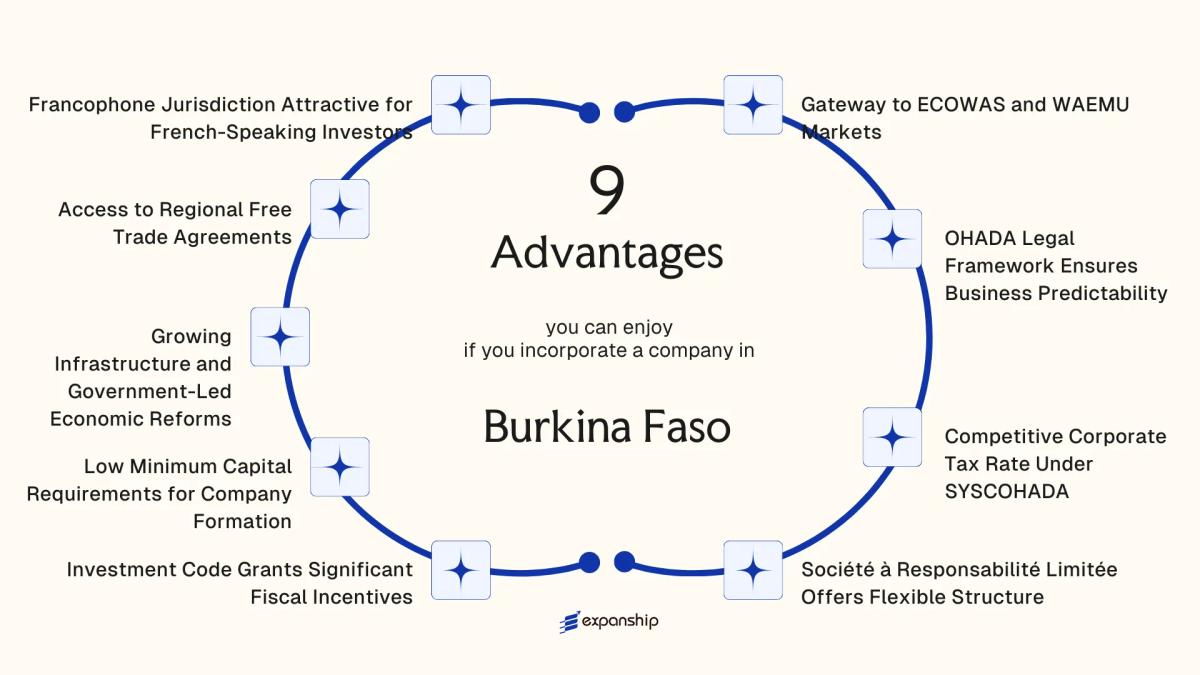
The benefits of incorporating in Burkina Faso span legal, fiscal, and market dimensions that are worth examining in detail. This article covers the substantive advantages that make Burkina Faso company formation a consideration for businesses targeting the West African region.
Gateway to ECOWAS and WAEMU Markets
Burkina Faso sits at the geographic center of West Africa, sharing borders with six countries and positioned directly within the ECOWAS free trade zone. For a foreign business owner, that location translates into documented market access, not a theoretical one.
ECOWAS Membership and What It Opens
Under the ECOWAS Trade Liberalization Scheme (ETLS), goods produced by registered community enterprises can move across member states without customs duties. A company incorporated in Burkina Faso and certified under the ETLS gains duty-free access to a combined market of over 400 million consumers across 15 member states, which meaningfully reduces the cost of cross-border distribution compared to operating from outside the bloc.
WAEMU Integration and Currency Stability
Burkina Faso is also a full member of the West African Economic and Monetary Union (WAEMU), whose eight member states share the CFA franc (XOF) and a common external tariff. Operating within a single-currency zone eliminates intra-regional exchange rate exposure for your business. WAEMU's common market framework also allows free movement of capital between member states, which simplifies repatriation and intra-group transfers for firms with multi-country operations.
A single incorporated entity in Burkina Faso can serve both ECOWAS and WAEMU markets under unified trade rules, reducing the need for multiple regional registrations.
OHADA Legal Framework Ensures Business Predictability
Burkina Faso operates under the OHADA legal framework, a supranational commercial law system ratified by 17 member states across Central and West Africa. For a foreign business owner, the OHADA legal framework benefits Burkina Faso companies directly: the Uniform Acts have direct legal force without requiring national transposition, which means the rules governing your company are the same texts applied in Abidjan, Douala, or Dakar.
This harmonisation removes a layer of uncertainty that typically accompanies cross-border operations. Commercial disputes can be referred to the Common Court of Justice and Arbitration (CCJA) in Abidjan, an institution with its own cassation jurisdiction over commercial matters. Your business does not have to rely solely on the domestic court system to enforce contracts or resolve shareholder disagreements.
Predictability in corporate law matters because it affects how you structure agreements, protect assets, and plan exits. Under OHADA's Uniform Act on Commercial Companies (AUDSC), the rules on company formation, governance, and dissolution are codified and consistently interpreted across member states.
Key features that directly support business predictability include:
- Contract enforcement standards are set at the supranational level, reducing exposure to inconsistent local jurisprudence
- Arbitration through the CCJA offers a neutral, internationally recognised forum outside the domestic judiciary
- Accounting rules under SYSCOHADA apply uniformly, making financial statements readable across the region

Company Incorporation in Burkina Faso
Incorporate your company in Burkina Faso with full OHADA compliance through Expanship's end-to-end formation service.
Competitive Corporate Tax Rate Under SYSCOHADA
Burkina Faso corporate tax rate advantages are anchored in a framework shaped by both domestic fiscal law and the SYSCOHADA accounting standards adopted across OHADA member states. The standard corporate income tax (CIT) rate stands at 27.5%, which sits below the rates applied in several comparable West African economies. For businesses that generate modest profits in early operating years, this rate directly reduces the tax burden on retained earnings available for reinvestment.
| Parameter | Detail |
|---|---|
| Standard CIT Rate | 27.5% |
| Minimum Flat Tax (IMF) | Applies when CIT liability falls below a statutory floor |
| Tax Accounting Standard | SYSCOHADA Revised (2017) |
| Tax Administration Body | Direction Générale des Impôts (DGI) |
| Filing Currency | West African CFA Franc (XOF) |
SYSCOHADA Revised, which came into force in 2018, standardized chart-of-accounts rules and financial reporting across the OHADA zone. For your business, this means that accounting practices familiar from other OHADA jurisdictions transfer directly, reducing the cost of engaging local accountants or restructuring internal reporting systems. Compliance overhead stays predictable from year one.
Tax filings are administered by the Direction Générale des Impôts. Resident companies are taxed on profits generated within the territory, while the treatment of foreign-sourced income depends on applicable tax treaties and the entity's residency classification under domestic rules.
Société à Responsabilité Limitée Offers Flexible Structure
The Société à Responsabilité Limitée Burkina Faso advantages begin with governance flexibility that most foreign investors underestimate. Under the OHADA Uniform Act on Commercial Companies, the SARL requires a minimum of one shareholder and can accommodate up to fifty, giving your business room to scale without converting to a different entity type. Decisions are distributed between shareholders and one or more gérants (managers), who need not be Burkinabè nationals or residents.
This separation of ownership and management has a direct practical effect. A foreign investor can appoint a local gérant to handle day-to-day affairs while retaining ownership control through the shareholder structure, reducing the need for constant physical presence in-country. The OHADA Uniform Act governs this framework uniformly across member states, so the rules are not subject to unilateral local revision.
Liability is capped at each shareholder's capital contribution. For a foreign entity structuring regional operations, this containment limits exposure on the Burkinabè side without affecting the parent company's balance sheet elsewhere.
Keep in mind:
- The SARL cannot issue shares to the public or list on a stock exchange
- Transfer of ownership shares (parts sociales) requires approval from existing shareholders
- A single-shareholder SARL is recognized as a valid structure under OHADA rules
- Management appointments and shareholder decisions must be documented in procès-verbaux (minutes) and retained for inspection
A single individual can form and wholly own an SARL in Burkina Faso without a local co-founder, a requirement that several neighboring OHADA jurisdictions impose in practice despite the uniform legislation.
Investment Code Grants Significant Fiscal Incentives
Burkina Faso's investment code fiscal incentives represent one of the more structured preferential tax frameworks in West Africa, codified under the Code des Investissements. Foreign investors who qualify under this framework gain access to phased tax reductions that directly lower the cost of establishing and operating a business in the country.
Phase-Based Tax Relief Under the Investment Code
The Code des Investissements organizes incentives into distinct phases tied to the investment amount and sector. During the establishment phase, qualifying firms benefit from exemptions on customs duties for imported equipment and materials necessary for project setup. The operative implication is immediate: capital expenditure costs are reduced before the business generates a single unit of revenue.
Once operational, approved entities may access corporate tax exemptions or reductions for a defined period. This temporal protection from full tax liability gives foreign-owned businesses a runway to achieve profitability without the full burden of the standard corporate tax rate applying from day one.
Sector-Specific Advantages and Eligibility Conditions
Priority sectors, including agro-industry, mining, and manufacturing, attract the most favorable treatment under the code. Investments directed at these areas may qualify for enhanced incentive tiers, which can include reduced business license taxes and relief from certain local levies.
Eligibility is not automatic. Your firm must submit an application to the Centre de Facilitation des Actes de Construire or the relevant approval body, and the investment must meet minimum thresholds specified in the code. Incentives are granted by formal approval, not by default registration.
Maximize Your Investment Code Benefits in Burkina Faso
Find out which fiscal incentive tier applies to your business and what approvals your investment requires under the Code des Investissements.
Low Minimum Capital Requirements for Company Formation
Under OHADA's Acte Uniforme relatif au droit des sociétés commerciales et du groupement d'intérêt économique (AUDSCGIE), a Société à Responsabilité Limitée can be formed with a minimum share capital of just XOF 1,000,000 (approximately USD 1,600). For early-stage businesses or foreign investors testing a new market, this threshold significantly reduces the financial barrier to establishing a legal presence.
Low minimum capital requirements in Burkina Faso translate into a concrete operational advantage: your capital is not locked into a statutory requirement when it could be deployed into staffing, inventory, or market development instead. Here is why this matters in practical terms:
- The XOF 1,000,000 floor for an SARL is substantially lower than minimum capital thresholds in several European civil law jurisdictions, meaning foreign founders retain greater liquidity from day one.
- Capital contributions can be made in cash or in kind under the AUDSCGIE, giving your business flexibility in how initial resources are structured.
- There is no prescribed timeline forcing paid-up capital to reach a higher level post-incorporation, which reduces ongoing compliance pressure during the early operating period.
- A single shareholder can meet the minimum threshold alone, removing the need for a co-founder solely to satisfy a statutory capital condition.
Growing Infrastructure and Government-Led Economic Reforms
Burkina Faso economic reforms benefits for business are most visible in the government's targeted investment in transport corridors, energy access, and digital infrastructure. The country sits at a crossroads linking coastal West Africa to the Sahel, and road expansion programs connecting Ouagadougou to border towns reduce logistics costs for firms operating regionally. For a foreign entity, lower distribution costs translate directly into improved unit economics.
Under the national economic development framework, the government has prioritized public-private partnership structures to accelerate infrastructure delivery. This creates entry points for foreign capital in sectors where state financing alone is insufficient, particularly in agro-processing and renewable energy.
The Autorité de Régulation des Communications Électroniques et des Postes (ARCEP) oversees an expanding telecoms sector, and rising mobile penetration rates support operational efficiencies for businesses relying on digital payment systems or remote management.
A World Bank assessment identified Burkina Faso as among the countries undertaking fiscal and structural reforms aimed at improving the business regulatory environment, with particular focus on reducing administrative processing times for commercial registrations. (World Bank, Doing Business Reform Memoranda, West Africa region)
Infrastructure growth business advantages compound over time: as connectivity improves, your firm's physical and operational costs in-country decrease without requiring additional investment on your end.
Access to Regional Free Trade Agreements
Burkina Faso free trade agreement advantages stem primarily from two overlapping frameworks: membership in the Economic Community of West African States (ECOWAS) and the African Continental Free Trade Area (AfCFTA). Together, these agreements give a registered entity preferential access to markets spanning hundreds of millions of consumers.
Under the ECOWAS Trade Liberalisation Scheme (ETLS), goods originating from approved companies circulate duty-free across member states. Qualifying for ETLS approval requires meeting defined rules of origin, but once granted, your firm can export across the region without the tariff friction that applies to non-member entities.
AfCFTA, operational since 2021, extends that reach across 54 African signatory nations. A firm incorporated in a participating country can position itself as a continental supply or distribution point under progressively reducing tariff schedules.
- ECOWAS ETLS covers 15 member states
- AfCFTA membership includes most of the African Union
- Both frameworks apply rules-of-origin conditions that determine eligibility
Regional trade benefits incorporating in Burkina Faso are most accessible to businesses in manufacturing, agro-processing, and traded services, where origin certification directly reduces landed costs for buyers across the region.
ETLS duty-free treatment applies only to goods that meet ECOWAS rules-of-origin thresholds; companies must obtain formal ETLS approval before assuming preferential treatment applies to their exports.
Francophone Jurisdiction Attractive for French-Speaking Investors
Burkina Faso francophone jurisdiction investor advantages extend beyond shared language. French is the official language of government, commerce, and the legal system, which means all corporate documentation, regulatory filings, and judicial proceedings are conducted in French. For investors and business owners who already operate in French, this eliminates the translation layer that adds cost and introduces interpretive risk in anglophone markets.
Operational Familiarity Reduces Administrative Friction
Corporate governance documents, including the statutes of a Société à Responsabilité Limitée or Société Anonyme, are drafted in French under the OHADA Uniform Acts. Contracts, tax filings submitted to the Direction Générale des Impôts, and labour agreements all follow French-language conventions that French-speaking legal and financial advisors can review without engaging local translators. This directly reduces your professional service costs from day one.
Regional Business Networks Align Along Language Lines
French-speaking business networks across WAEMU member states, including Côte d'Ivoire, Senegal, and Mali, share common commercial and legal vocabulary. An entity incorporated here can engage counterparts in those markets with minimal communication barriers, which simplifies cross-border contracting, banking relationships, and due diligence processes.
Familiar Civil Law Tradition
The civil law framework governing commercial activity derives from the French legal tradition, which is the same system used across much of continental Europe and Francophone Africa. Investors from France, Belgium, Switzerland, Canada's Quebec province, or other civil law jurisdictions will find the structural logic of contract formation, liability rules, and corporate governance largely consistent with their home systems.
How Burkina Faso Stacks Up Against Other West African Jurisdictions
The Burkina Faso vs West Africa jurisdictions comparison is most meaningful when set against Ghana, Côte d'Ivoire, and Senegal — three markets that foreign investors evaluating West African entry points regularly consider. All four operate within overlapping trade frameworks, yet they differ in tax structure, incorporation cost, and the legal systems governing commercial disputes. The comparison below focuses on parameters where the differences carry practical weight for a business deciding where to register.
Shared OHADA membership among Burkina Faso, Côte d'Ivoire, and Senegal means commercial law is largely harmonised across those three markets, which reduces legal due diligence costs when operating across borders. Ghana, operating under common law, requires separate legal adaptation. On corporate tax, Burkina Faso's standard rate sits below Côte d'Ivoire's 25% and matches Senegal's 30% ceiling only when investment code exemptions apply. Minimum capital requirements for an SARL remain among the more accessible in the OHADA zone. For details on the OHADA treaty framework, the official OHADA portal provides the consolidated uniform acts.
| Parameter | Burkina Faso | Côte d'Ivoire | Senegal | Ghana |
|---|---|---|---|---|
| Legal System | OHADA (Civil Law) | OHADA (Civil Law) | OHADA (Civil Law) | Common Law |
| Standard Corporate Tax Rate | 27.5% | 25% | 30% | 25% |
| SARL Minimum Capital | No statutory minimum (post-reform) | No statutory minimum | No statutory minimum | N/A (Ltd by shares) |
| WAEMU Membership | Yes | Yes | Yes | No |
| Investment Code Fiscal Incentives | Yes | Yes | Yes | Yes |
| Official Business Language | French | French | French | English |
Compliance Services for Companies in Burkina Faso
Maintain your entity's good standing with annual filings, statutory obligations, and regulatory reporting across Burkina Faso's legal framework.
Conclusion
Burkina Faso presents a structured case for incorporation that holds up across legal, fiscal, and market dimensions. The OHADA Uniform Acts provide a commercially predictable legal foundation that operates independently of domestic legislative instability, and the Investment Code's tax exemption periods translate directly into lower operating costs during the years when capital is most constrained. For businesses targeting West Africa, the WAEMU and ECOWAS memberships extend the commercial footprint of a single registered entity well beyond the country's borders.
The benefits of incorporating in Burkina Faso are most pronounced for firms that can align their activities with the Investment Code's eligible sectors, or those seeking a Francophone entry point into the broader regional market. A holding company, a regional trading entity, or a services firm serving French-speaking West Africa will each find different aspects of the framework most relevant to their structure.
The right fit depends on your industry, your ownership preferences, and how your corporate structure intersects with OHADA rules on capital and governance. Understanding which approval body, whether the Centre de Formalités des Entreprises or a sectoral authority, governs your specific activity is part of any accurate formation assessment. With those variables established, the formation process and the regulatory framework that follows are well-defined enough to support long-term planning.
Start Your Burkina Faso Company Formation With Expanship Today
Burkina Faso company formation with Expanship covers the full incorporation cycle for entity types discussed throughout this blog, including the Société à Responsabilité Limitée and the Société Anonyme, under the OHADA Uniform Act on Commercial Companies. From coordinating filings with the Centre de Formalités des Entreprises to ensuring compliance with the Code Général des Impôts, the service scope is structured around the specific regulatory requirements that apply to foreign-owned businesses registered in Ouagadougou.
Expanship's support for incorporate in Burkina Faso with Expanship engagements covers each stage of the setup and maintenance process:
- Document preparation, notarization, and legalization for RCCM registration
- Registered agent and registered office provision in Ouagadougou
- Government filing and liaison with the Centre de Formalités des Entreprises
- Post-incorporation compliance management, including annual filings under SYSCOHADA reporting obligations
- Banking introduction assistance to support account opening for newly registered entities
- Coordination with the Direction Générale des Impôts for tax registration and identification number issuance
Contact Expanship Burkina Faso to discuss your entity formation requirements.
Frequently Asked Questions (FAQ)
Registration through the Centre de Formalités des Entreprises (CEFORE) is designed to consolidate multiple administrative steps into a single window, with processing times generally ranging from a few days to two weeks depending on document completeness. The actual timeline varies based on the legal form chosen and whether notarial involvement is required, as an SARL with a notarised deed may take longer than a simpler structure. Delays typically arise from authentication of foreign-origin documents rather than the CEFORE process itself.
The standard corporate income tax rate in Burkina Faso is 27.5%, applicable to net taxable profits reported under the SYSCOHADA accounting system. Companies qualifying for incentive regimes under the Investment Code may benefit from reduced rates or temporary exemptions during an approved establishment phase. The applicable rate and any exemptions are confirmed at the time of investment approval by the relevant authority.
The Investment Code provides for tax and customs exemptions during a defined investment phase, which can include relief on corporate tax, business licence tax (patente), and import duties on qualifying equipment. The Centre de Promotion des Investissements au Burkina (CEPIB) is the primary body responsible for processing investment approval applications and overseeing incentive eligibility. The duration and scope of incentives vary according to the investment amount and the economic sector targeted.
Contract enforcement is governed by the OHADA Uniform Act on General Commercial Law, which applies uniformly across all 17 OHADA member states including Burkina Faso. This supranational framework reduces the dependence on domestic legislative consistency and provides standardised rules on contract formation, proof, and remedies. Dispute resolution options include national courts applying OHADA rules and arbitration through the Common Court of Justice and Arbitration (CCJA) based in Abidjan.
An SARL (Société à Responsabilité Limitée) can be formed with a minimum share capital of XOF 1,000,000 (approximately USD 1,600 at prevailing rates) under the OHADA Uniform Act on Commercial Companies. The capital must be fully subscribed at incorporation, though the payment schedule for cash contributions follows the rules set out in the Uniform Act. This figure is relatively accessible compared to a Société Anonyme, which carries a higher statutory minimum.
Membership in the West African Economic and Monetary Union (WAEMU) means your business operates within the CFA franc (XOF) zone, which is pegged to the euro and managed through the Banque Centrale des États de l'Afrique de l'Ouest (BCEAO). This peg eliminates intra-zone exchange rate risk for transactions with other WAEMU members and provides a degree of monetary stability relevant to financial planning. WAEMU also maintains common external tariff rules, which affect how goods imported from outside the union are taxed at the border.
If a company does not fulfil the investment commitments specified in its approval, the incentives granted under the Investment Code can be withdrawn and tax exemptions reversed. The applicable rules generally provide for a recovery of unpaid taxes corresponding to the period during which the conditions were not met. Maintaining accurate records of capital expenditure, job creation, or other benchmarks tied to the approval is therefore essential to preserving the incentive status.
Legal Disclaimer
The information provided in this article is for general informational purposes only and does not constitute legal, tax, or professional advice. While we strive to ensure the accuracy and timeliness of the content, laws and regulations are subject to change, and the application of laws can vary widely based on specific facts and circumstances.
Readers should not act upon this information without seeking professional counsel tailored to their individual situation. Expanship and its authors disclaim any liability for actions taken or not taken based on the content of this article.
For specific advice regarding your business setup, compliance requirements, or any legal matters, please consult with qualified legal and tax professionals in the relevant jurisdiction.